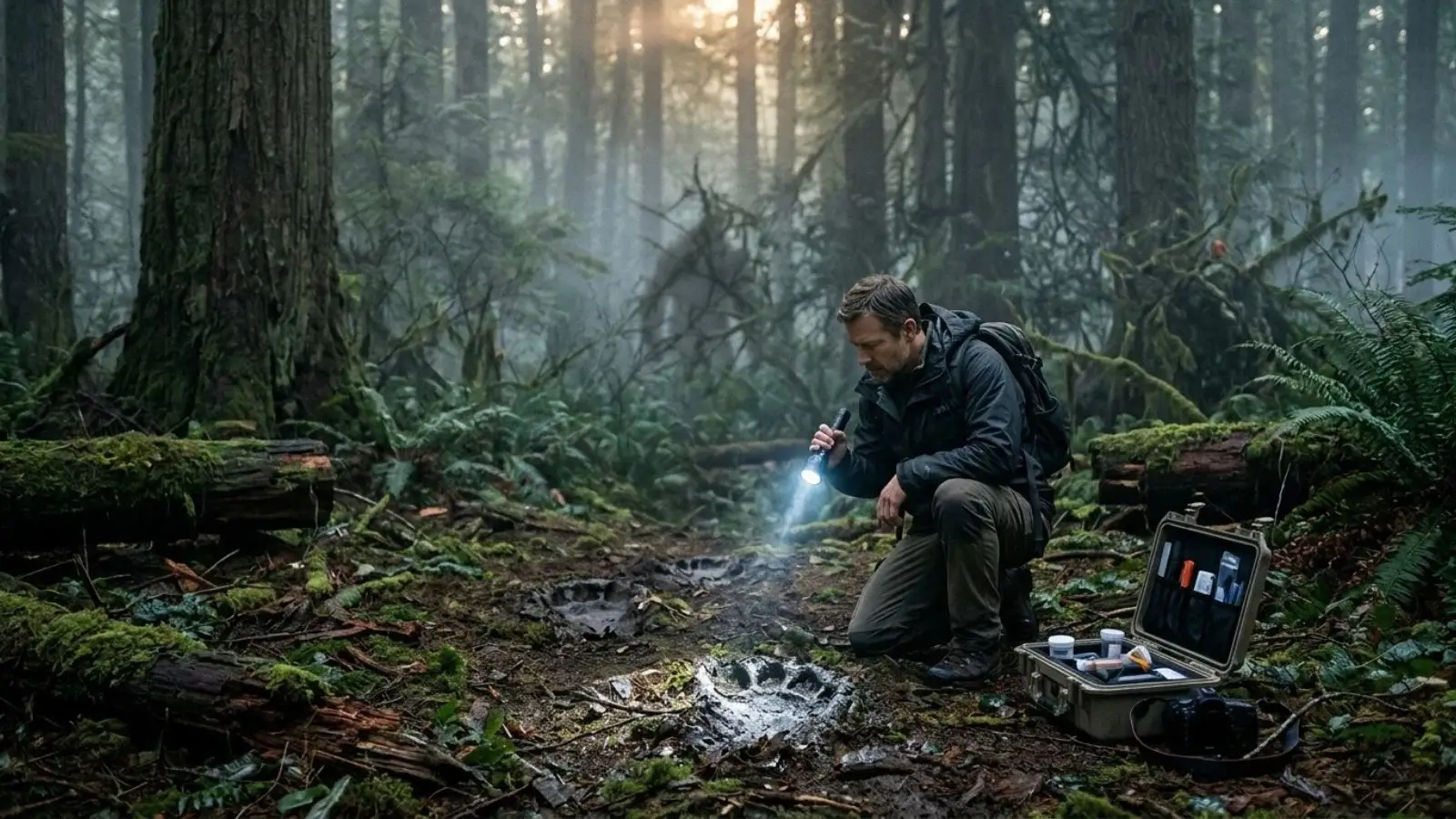
Imagine walking through a remote forest and finding enormous footprints that do not seem to match any animal you recognize.
Or imagine seeing a strange shape moving beneath the surface of a deep lake. Would you believe you had discovered a creature unknown to science, or would you look for a more ordinary explanation?
Questions like these have fascinated people for generations. From Bigfoot sightings in North American forests to stories about mysterious lake monsters, reports of unusual creatures continue to capture our imagination.
These stories form an important part of cryptozoology, a field concerned with investigating animals whose existence has not been scientifically confirmed.
However, curiosity alone cannot prove that a creature exists. Modern forensic methods, including DNA analysis, photographic examination, and biological testing, offer practical ways to investigate unusual claims.
They can help separate reliable evidence from mistaken observations, misleading stories, and deliberate hoaxes.
Understanding cryptozoology myths is not simply about deciding if legendary creatures are real. It is about learning how evidence works.
Why people believe extraordinary stories, and how scientific investigation can turn mysterious claims into questions that can actually be tested.
What Is Cryptozoology?
Cryptozoology focuses on reports of animals that have not been formally recognized by mainstream science.
The word is commonly associated with mysterious creatures such as Bigfoot, the Loch Ness Monster, and the Yeti. Researchers and enthusiasts investigate reported sightings, alleged physical traces, local stories, and possible explanations for unusual animal encounters.
It is important to understand that cryptozoology is not generally considered an established scientific discipline in the same way as zoology or forensic biology.
Many claims associated with it lack independently verifiable evidence. Nevertheless, examining these claims can introduce useful questions about animal identification, field observation, and scientific reasoning.
History also offers an important distinction. Some animals once unknown to Western science, including the okapi, were eventually documented through physical specimens and reliable observations.
Their discovery does not prove that every legendary creature exists. Instead, it demonstrates that new discoveries require evidence that other investigators can examine and verify.
The central question is therefore not if a story sounds convincing. It is if the available evidence supports the existence of the animal being described.
Why Do These Myths Survive?
Cryptozoology myths often survive because they combine uncertainty, cultural traditions, personal experiences, and the human desire to discover something extraordinary.
Consider a person who sees a large animal moving through dense woodland at dusk. Poor lighting, distance, fear, and a brief viewing time may make accurate identification difficult.
An ordinary bear or another known animal could appear unfamiliar under those conditions. When the account is shared, additional details may gradually become part of the story.
Cultural traditions also influence how people interpret unusual encounters. Communities around the world have stories about mysterious beings, powerful animals, and creatures associated with particular landscapes.
These stories may communicate cultural values, explain frightening experiences, or preserve local history. They should not automatically be treated as literal zoological descriptions.
Social media adds another layer. A blurry photograph or dramatic video can reach thousands of people before anyone checks its origin.
Repeated sharing may make a claim appear more credible, even when every post traces back to the same unverified source.
Understanding these influences does not mean dismissing every witness. It means recognizing that sincere people can misinterpret what they see and that a compelling story is not the same as confirmed evidence.
Bigfoot: Following the Footprints
Bigfoot, sometimes called Sasquatch, is one of the best known examples of a creature associated with cryptozoology myths.
Reports generally describe a large, hairy, humanlike figure living in forests across parts of North America. Alleged footprints, eyewitness accounts, photographs, and videos have helped keep the legend alive.
Footprints may initially appear to offer strong physical evidence. Investigators can measure their length and width, examine stride patterns, assess depth, and compare impressions with known animal tracks.
They can also look for signs of footwear, repeated impressions, or irregularities suggesting that a print was manufactured.
However, a large footprint does not automatically establish the presence of an unknown primate.
Bears and other animals can leave unusual tracks under certain conditions, while mud, melting snow, and uneven ground can distort an impression. Artificial tracks are another possibility that must be considered.
A useful investigation would document the location, photograph the tracks with a scale, record the surrounding conditions, and collect any relevant material using appropriate procedures. If biological samples are available, DNA testing might help identify their source.
To date, Bigfoot has not been established as a real animal species through verified scientific evidence.
That conclusion could change only if reliable, independently testable evidence emerged. Until then, footprints and eyewitness accounts remain claims requiring careful evaluation.
The Loch Ness Monster Mystery
Scotland’s Loch Ness has become internationally famous for stories about a large, unidentified creature living beneath its dark waters. Commonly known as Nessie, the creature is often portrayed in popular culture as a long necked aquatic animal.
The mystery has attracted photographs, eyewitness reports, underwater searches, sonar investigations, and scientific studies. Yet underwater environments create significant challenges for identification.
Waves, shadows, floating vegetation, swimming animals, and unusual viewing angles can produce misleading impressions.
Photographs require particular care. Investigators need to examine the original image whenever possible, check its history, assess the camera angle, and consider if objects in the water provide a reasonable explanation.
An image that appears convincing without context may look very different when its scale and surroundings are understood.
Environmental DNA, or eDNA, offers another approach. Organisms leave small traces of genetic material in water through skin cells, mucus, waste, and other biological material.
Scientists can collect water samples and analyze the DNA they contain to identify organisms that may have been present.
A major 2018 environmental DNA survey of Loch Ness found genetic material from numerous organisms, including substantial evidence of eels.
The study did not establish the presence of a giant unknown reptile. Although eDNA can reveal useful information about aquatic life.
It also has limitations: results depend on sampling methods, detection sensitivity, contamination controls, and how DNA is interpreted.
The Loch Ness story shows how modern methods can investigate a famous legend without assuming the answer in advance.
How Modern Forensics Tests Claims
Forensic science can help investigators assess unusual animal reports by applying systematic methods to physical and digital evidence.
The goal is not to prove a legend right or wrong before the investigation begins. It is to determine what the evidence can reliably tell us.
Several techniques are especially useful.
DNA analysis: Biological samples such as hair, feathers, tissue, or saliva may contain genetic material. Laboratory analysis can sometimes identify the species that produced a sample. However, damaged or contaminated DNA can complicate the results, and a sample’s collection history matters.
Microscopic examination: Hair and other biological materials can be examined for structural characteristics. These features may help narrow down possible sources, although visual examination alone does not always establish a definitive identification.
Photographic and video analysis: Investigators can study image metadata, lighting, perspective, motion, editing artifacts, and the object’s apparent size. Original files are generally more useful than repeatedly compressed copies shared online.
Footprint analysis: Measurements, stride patterns, ground conditions, and comparisons with known animal tracks can help determine if an impression is consistent with a familiar species or may have been altered.
Environmental sampling: Soil, water, and other environmental materials may contain biological traces. Proper sampling, contamination prevention, and laboratory controls are essential for meaningful results.
No single technique is a magic solution. Reliable conclusions usually depend on multiple lines of evidence, transparent methods, and independent review.
Can DNA Reveal Unknown Creatures?
DNA analysis has transformed wildlife research by allowing scientists to identify species from biological traces that might otherwise be difficult to interpret.
In some situations, researchers can obtain useful genetic information without capturing or even seeing the animal itself.
For example, a hair sample found near a remote trail may be compared with reference DNA from known mammals.
If the result matches a bear, deer, or another documented species, that information can help explain an alleged encounter.
If a sample produces an unusual result, investigators must check if the finding reflects contamination, degraded material, an incomplete reference database, or a genuinely unexpected organism.
An unfamiliar genetic sequence does not automatically mean that a mythical creature has been discovered.
Scientists need to repeat the analysis, verify the sample’s origin, rule out contamination, and determine if the sequence belongs to a known but poorly documented species.
There are also practical limitations. A sample may contain DNA from several animals, and environmental DNA can travel through water or be transported by other means. Finding genetic material at a location does not always prove that a particular creature was physically present exactly where the sample was collected.
A credible discovery would require reproducible findings and sufficient evidence to describe the organism reliably. DNA can be a powerful investigative tool, but its conclusions must be interpreted carefully.
Hoaxes, Mistakes, and False Evidence
Some cryptozoology claims result from deliberate deception. Others emerge from honest mistakes, incomplete information, or the natural tendency to interpret uncertain observations as meaningful.
Hoaxes may involve artificial footprints, altered photographs, staged videos, or biological samples presented without a trustworthy history.
Digital editing tools make it easier to create convincing images, while social media can spread them faster than they can be checked.
Investigators should therefore ask several basic questions. Is the original evidence available? Who collected it? Can the collection process be independently verified? Has the sample been examined by a qualified laboratory? Do independent witnesses or records support the claim?
A concept called chain of custody is particularly important when physical evidence is collected. It records who handled a sample, when it was transferred, how it was stored, and if its identity remained secure.
Without this information, even a technically accurate laboratory result may be difficult to connect to the original sighting.
It is also important to distinguish fraud from error. A witness who misidentifies an animal has not necessarily lied. Responsible investigation evaluates the evidence without automatically accusing people of dishonesty.
The strongest approach is neither blind belief nor instant rejection. It is a careful verification.
What Could a Real Discovery Change?
If a previously unknown large animal were confirmed, the discovery could have important implications for zoology, ecology, conservation, and our understanding of biodiversity.
Scientists would need to determine its physical characteristics, genetic relationships, habitat requirements, diet, behavior, and population size.
The process would take time. Researchers would need independently verifiable evidence, such as suitable physical specimens, well documented observations, or multiple complementary forms of evidence.
Depending on the organism and circumstances, ethical and legal requirements would also influence how it could be studied.
A confirmed species might require habitat protection or new conservation measures. Its existence could also raise questions about how an animal remained undocumented, particularly if it were large, widespread, and expected to leave frequent traces.
However, scientific discovery does not require every mystery to involve a giant creature. Better knowledge of animal behavior, overlooked species, environmental DNA, and remote habitats can reveal fascinating facts without confirming popular legends.
For readers, the most useful lesson is that science remains open to new evidence while requiring strong support for extraordinary claims. Curiosity encourages investigation; verification makes the resulting knowledge trustworthy.
FAQs
Is cryptozoology a recognized science?
Cryptozoology is generally regarded as a fringe or non mainstream field rather than an established scientific discipline.
However, some of the questions associated with it can be investigated using accepted scientific methods, including zoology, genetics, and forensic analysis.
Does Bigfoot really exist?
Bigfoot has not been confirmed as a real animal species through reliable, independently verified scientific evidence. Eyewitness accounts and alleged footprints have not established its existence.
Can forensic science prove that a legendary creature is real?
Forensic methods can test specific claims by examining DNA, biological traces, footprints, photographs, and other evidence.
If those results support a new species depends on the quality, reliability, and reproducibility of the findings.
What is environmental DNA?
Environmental DNA, or eDNA, is genetic material collected from environmental samples such as water, soil, or air. Scientists use it to detect organisms that may have left biological traces in a particular environment.
Why do people continue to believe in cryptozoology myths?
Cultural traditions, personal experiences, uncertainty, emotional interest, and repeated online exposure can all contribute. Some people also enjoy exploring unexplained questions even when evidence remains inconclusive.
Could scientists discover an unknown animal in the future?
Yes. New animal species continue to be documented, particularly in habitats that are difficult to study. However, discovering a new species requires reliable evidence rather than stories or unexplained images alone.
Conclusion:
Cryptozoology myths occupy an intriguing space between folklore, curiosity, and scientific investigation. Stories about Bigfoot, the Loch Ness Monster, and other mysterious creatures remind us how strongly people are drawn to the unknown.
Modern forensic methods provide practical ways to investigate these stories. DNA analysis, footprint examination, image verification, and environmental sampling can help identify ordinary explanations, expose unreliable evidence, and investigate unusual findings.
The key is to remain curious without abandoning critical thinking. A mystery deserves investigation, but a convincing story is not proof, and an unexplained observation does not automatically establish a new species.
The next time a mysterious creature appears in a photograph or a strange footprint is reported in a forest, ask what the evidence actually shows.
Sometimes the explanation will be surprisingly ordinary. Other times, further research may reveal something genuinely interesting. In either case, careful investigation brings us closer to understanding the natural world.

I’m Noah Richardson, a writer and fact finder who enjoys investigating topics from different angles. I’m especially interested in the details people often overlook and the surprising information hidden inside familiar subjects. My work at Factopea is about making those discoveries accessible through straightforward, engaging writing. I take pride in researching each topic carefully and presenting the information in a way that respects the reader’s time and curiosity.
Books: The Fact Finder’s Handbook and More Than Meets the Eye