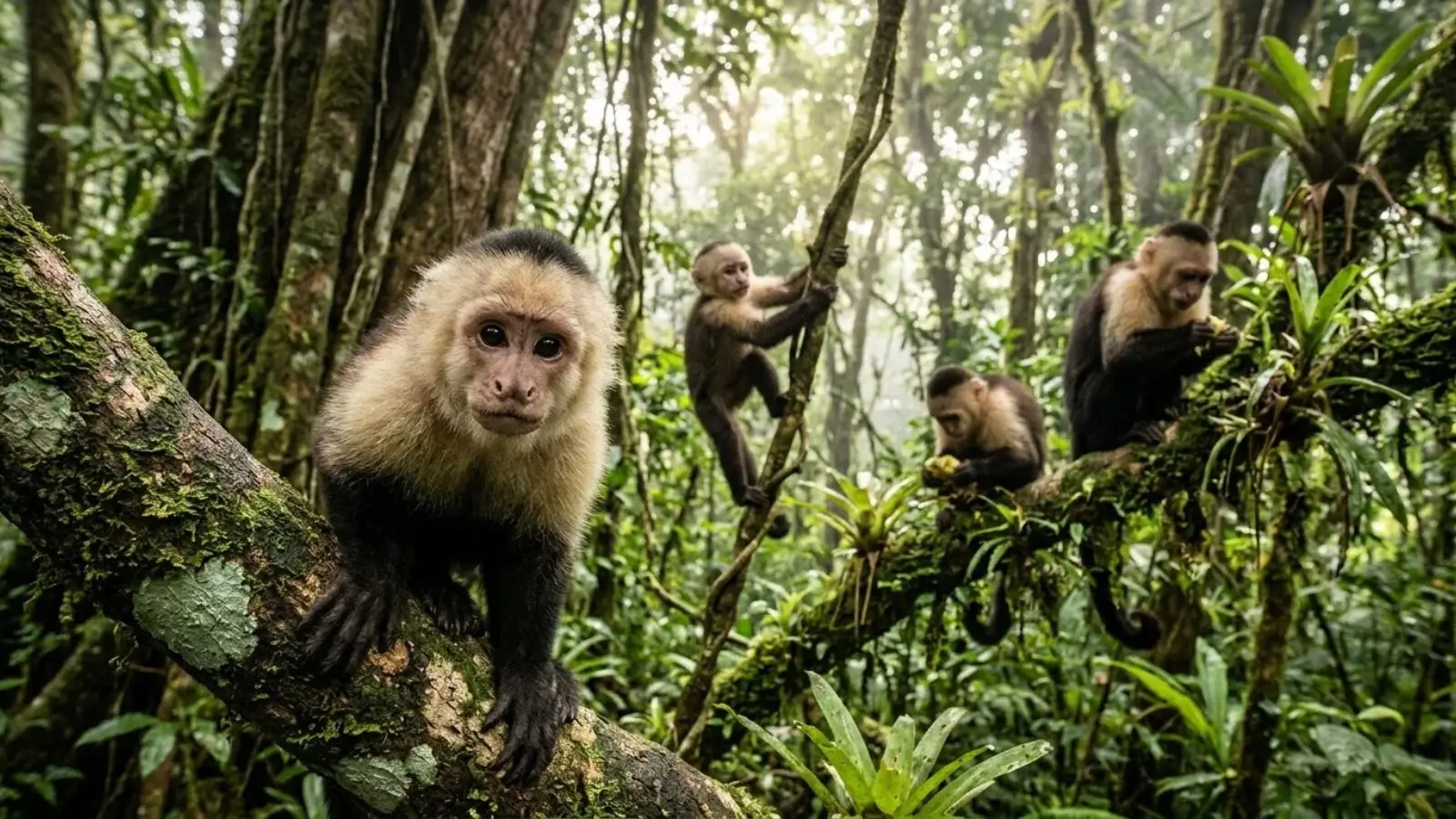
Monkeys are among the most fascinating animals in the natural world. Their intelligence, expressive faces, playful personalities, and ability to adapt to different environments have captured human attention for centuries.
From swinging through tropical rainforests to surviving in cold mountain regions, these remarkable primates display an extraordinary range of behaviors and adaptations.
But monkeys are much more than entertaining wildlife. They form complex social groups, communicate through sounds and body language, solve problems, and play important roles in maintaining healthy ecosystems.
Some even use simple tools, learn new behaviors from one another, and pass knowledge through their communities.
If you want to discover how monkeys live, what they eat, how they evolved, and why they matter, this guide covers everything you need to know. Explore these Interesting Facts About Monkeys to understand their diversity, intelligence, habitats, behavior, and the challenges they face in the modern world.
Quick Facts About Monkeys
| Feature | Details |
| Scientific Group | Primates |
| Number of Species | More than 260 recognized species |
| Main Groups | Old World and New World monkeys |
| Natural Habitats | Rainforests, mountains, grasslands, and woodlands |
| Geographic Range | Africa, Asia, Central America, and South America |
| Average Lifespan | Varies considerably by species |
| Diet | Fruits, leaves, seeds, insects, flowers, and other foods |
| Largest Monkey | Mandrill |
| Smallest Monkey | Pygmy marmoset |
| Closest Living Relatives | Apes, including humans |
| Conservation Status | Ranges from Least Concern to Critically Endangered |
Understanding Monkeys and Their Unique Characteristics
Monkeys are mammals belonging to the primate group. They are divided into two major categories: Old World monkeys, which naturally occur in Africa and Asia, and New World monkeys, which live in Central and South America.
These groups differ in several physical characteristics, including their noses, teeth, and tails. Most monkeys have tails, although their shape and function vary between species.
Some New World monkeys, such as spider monkeys, have prehensile tails that can grip branches and support their body weight.
Monkeys have forward-facing eyes, flexible hands, and relatively developed brains. These features help them recognize their surroundings, find food, interact with other members of their groups, and respond to changing conditions.
Unlike apes, monkeys generally have tails. However, not every primate with a tail is a monkey, and several other characteristics are used by scientists to distinguish different primate groups.
The Evolution and History of Monkeys
The evolutionary history of monkeys reaches back tens of millions of years. Their ancestors developed from earlier primates as populations adapted to changing climates, food sources, and habitats.
Scientists generally divide monkeys into two evolutionary branches. Old World monkeys belong to the catarrhine group, while New World monkeys belong to the platyrrhine group.
These lineages developed separately and gradually acquired different physical and behavioral characteristics.
New World monkeys are believed to have originated from ancestral African primates that reached South America millions of years ago.
One leading explanation is that small groups crossed the Atlantic on natural vegetation rafts, although the precise details of this journey remain a subject of scientific study.
Monkeys have also influenced human culture throughout history. They appear in ancient artwork, religious traditions, folklore, and literature. In Hindu traditions, Hanuman is an important figure associated with strength, courage, and devotion.
Today, researchers study monkeys to understand primate evolution, communication, social relationships, learning, and other aspects of animal biology.
20 Interesting Facts About Monkeys
1. There Are More Than 260 Monkey Species
Monkeys are an extremely diverse group of mammals, with more than 260 recognized living species. They range from tiny marmosets to large mandrills, each possessing physical and behavioral adaptations suited to its environment.
Some species spend most of their lives in trees, while others regularly travel across the ground. Their diversity helps them occupy different ecological niches throughout their natural ranges.
2. Monkeys Live in More Than Just Rainforests
Tropical rainforests are important monkey habitats, but they are not the only places where these animals survive. Japanese macaques inhabit cold regions, while geladas live in the highlands of Ethiopia.
Other species occupy dry forests, savannas, mangroves, and mountainous landscapes. Their ability to adjust to different environmental conditions is one reason monkeys have become so widespread.
3. Most Monkeys Have Tails
A tail is one of the most recognizable features of monkeys. Most species possess one, although its length, shape, and usefulness vary.
Old World monkeys generally have non-prehensile tails, meaning they cannot use them to grip branches. Some New World monkeys, however, have highly developed tails that act almost like an additional limb.
4. Some Monkeys Use Their Tails Like an Extra Hand
Spider monkeys have strong, muscular prehensile tails that help them move through forest canopies. Their tails have a sensitive gripping surface and can support much of their body weight.
This adaptation allows them to hang from branches while reaching for food or moving between trees. It is particularly useful in dense forests where climbing and balance are essential.
5. Monkey Groups Have Complex Social Structures
Many monkeys live in organized communities. Depending on the species, groups may include family members, unrelated individuals, dominant males, and several generations of offspring.
Members often form friendships and alliances, compete for social positions, and cooperate when facing danger. These relationships influence feeding opportunities, protection, and reproduction.
6. Monkeys Communicate in Different Ways
Monkeys use vocal calls, facial expressions, gestures, and body movements to communicate.
Different sounds may warn group members about predators, express distress, or help individuals stay connected. Facial expressions and body posture also communicate emotions and social intentions.
Their communication systems are more complex than simple sounds, although they differ considerably between species.
7. Some Monkeys Are Skilled Problem-Solvers
Capuchin monkeys are well known for their ability to solve practical problems. In certain populations, they use stones to crack open hard-shelled foods and may use other objects to access resources.
These behaviors demonstrate that monkeys can learn from experience, explore their surroundings, and develop useful techniques for obtaining food.
8. Japanese Macaques Have Learned to Wash Food
Japanese macaques have been observed washing sweet potatoes in water before eating them. This behavior became famous because it spread through social learning within a monkey group.
The discovery helped researchers understand how new behaviors can develop and spread among animals. It also provides an interesting example of how local traditions may emerge in wildlife communities.
9. The Pygmy Marmoset Is the Smallest Monkey
The pygmy marmoset is recognized as the world’s smallest monkey. Its body is only around 12–15 centimeters long, excluding its tail, although measurements vary between individuals.
These tiny primates live in the forests of the Amazon Basin. They are excellent climbers and mainly feed on tree gum and sap, along with insects and other small food items.
10. Mandrills Are the Largest Monkeys
Mandrills are the largest living monkey species. They are especially recognizable because adult males have brightly colored faces featuring blue ridges and red markings.
Their colorful appearance is connected to social signaling and can communicate information about an individual’s condition and status. Mandrills mainly inhabit tropical forests in parts of Central Africa.
11. Many Monkeys Recognize Familiar Faces
Recognizing other individuals is important in monkey societies. Research has shown that several monkey species can distinguish familiar group members from strangers.
This ability helps maintain social relationships, recognize family members, and respond appropriately to potential rivals or unfamiliar animals.
12. Grooming Builds Strong Social Bonds
Grooming is an important part of daily life for many monkeys. They carefully remove dirt, parasites, and loose hair from one another.
However, grooming is not simply about cleanliness. It also strengthens social relationships, reduces tension, and helps maintain cooperation within a group.
13. Some Monkeys Are Excellent Swimmers
Although many monkeys spend most of their time in trees or on land, certain species are comfortable in water.
Proboscis monkeys, native to Borneo, are particularly strong swimmers. Their partially webbed feet help them move through rivers and cross waterways when necessary.
14. Play Helps Young Monkeys Develop Important Skills
Young monkeys spend considerable time chasing, climbing, wrestling, and exploring.
These activities help them develop coordination, strength, balance, and social awareness. Play also provides opportunities to practice behaviors they will need as adults.
15. Monkeys Help Forests Regenerate
Many monkey species eat fruits and spread seeds through their droppings. This process helps plants grow in new locations and supports forest regeneration.
By dispersing seeds away from parent trees, monkeys contribute to plant diversity and help maintain healthy forest ecosystems.
16. Different Monkey Species Have Different Diets
Monkey diets depend on their species, habitat, and the food available throughout the year.
Some mainly eat fruit, while others consume leaves, seeds, flowers, tree gum, or insects. Certain species also eat eggs and small animals.
This dietary variety allows different monkey species to use different food resources within the same broad environment.
17. Some Monkeys Have Adapted to Urban Environments
In several regions, monkeys live close to human settlements. Urban populations may learn to recognize food containers, navigate buildings, and take advantage of easily available food.
These adaptations demonstrate their ability to observe and learn from changing environments. However, close contact with people can create problems, including injuries, food-related health issues, and conflict.
18. Color Vision Helps Monkeys Find Food
Many monkeys have well-developed color vision. Depending on the species and individual, their ability to distinguish colors can help them identify ripe fruits, young leaves, and other useful food sources.
Color vision may also contribute to recognizing social signals and navigating complex forest environments.
19. Many Monkey Species Are Threatened
Habitat destruction, hunting, illegal wildlife trade, pollution, and climate change threaten numerous monkey populations.
Species with small geographic ranges or specialized habitat requirements can be particularly vulnerable. Conservation programs, protected forests, and responsible wildlife tourism can help reduce these pressures.
20. Humans and Monkeys Share Ancient Common Ancestors
Humans did not evolve from any monkey species living today. Instead, humans and modern monkeys share ancient primate ancestors.
Studying monkeys helps scientists understand how primate bodies, brains, communication, and social behavior evolved over millions of years. Their similarities and differences also provide valuable insights into human evolution.
Monkey Behavior and Social Life
Family Relationships and Group Living
Many monkey species live in social groups that provide protection, companionship, and opportunities for cooperation. Group sizes vary widely, from small family units to communities containing many individuals.
Mothers usually play a central role in raising their young. In some species, other group members also help protect or care for infants.
Grooming, Friendship, and Social Hierarchies
Social grooming is one of the most important activities in many monkey communities. Individuals often groom relatives, friends, and valuable social partners.
Some species have clearly defined dominance hierarchies, while others display different patterns of social organization. Relationships can influence access to food, mates, and preferred resting places.
Learning Through Observation
Monkeys can learn by watching other members of their group. Young individuals often observe adults while searching for food, using objects, or responding to potential threats.
When useful behaviors spread through a community, they may become local traditions. These patterns are an important subject in animal behavior research.
What Do Monkeys Eat?
Fruits, Leaves, and Plant Foods
Many monkeys consume fruits, leaves, flowers, seeds, nuts, and other plant materials. Fruit provides energy, while leaves can supply important nutrients.
Some species specialize in particular foods, such as tree gum or young leaves, while others have more flexible diets.
Insects and Other Animal Foods
Depending on the species, monkeys may also eat insects, eggs, spiders, and small vertebrates. These foods provide protein and other nutrients that may be less available in plant-based diets.
Seasonal Changes in Feeding Habits
Food availability changes throughout the year. During periods when fruit is scarce, some monkeys shift toward leaves, seeds, insects, or other available resources.
Their feeding flexibility helps them survive in environments where food supplies change with the seasons.
FAQS
What is the most interesting fact about monkeys?
One of the most fascinating facts is that some monkeys use tools, learn behaviors from other individuals, and develop local traditions. These abilities reveal how intelligent and socially adaptable they can be.
How many monkey species exist in the world?
Scientists recognize more than 260 living monkey species. They are generally divided into Old World monkeys from Africa and Asia and New World monkeys from Central and South America.
What is the difference between monkeys and apes?
Most monkeys have tails, while apes do not. Apes also have different skeletal and body features, including more flexible shoulders. Humans, chimpanzees, gorillas, and orangutans are apes rather than monkeys.
Which monkey is the smallest in the world?
The pygmy marmoset is the smallest living monkey. Its body measures approximately 12–15 centimeters, excluding its tail.
Which monkey is the largest?
The mandrill is the largest living monkey species. Adult males are particularly large and have distinctive colorful facial markings.
Are monkeys intelligent animals?
Yes. Many monkeys demonstrate learning, memory, problem-solving, communication, and social intelligence. Some species also use tools and learn useful behaviors by observing others.
What do monkeys eat?
Their diets vary by species. Common foods include fruits, leaves, flowers, seeds, nuts, insects, tree sap, and occasionally eggs or small animals.
Why are monkeys important to forests?
Many monkeys disperse seeds after eating fruit, helping plants grow in new areas. This supports forest regeneration and contributes to biodiversity.
Are all monkey species endangered?
No. Their conservation status varies between species. Some have stable populations, while others face serious threats from habitat destruction, hunting, and illegal wildlife trade.
Can monkeys live in cold climates?
Yes. Japanese macaques are a well-known example of monkeys that survive in snowy environments. Their thick seasonal coats and behavioral adaptations help them cope with cold weather.
Conclusion
Monkeys are remarkable primates with diverse lifestyles, impressive intelligence, and complex social relationships.
From the tiny pygmy marmoset to the powerful mandrill, each species has developed unique adaptations that help it survive in its natural environment.
These Interesting Facts About Monkeys show that monkeys are not simply playful animals. They contribute to forest regeneration, support biodiversity, and offer valuable insights into primate evolution and behavior.
However, habitat loss, hunting, and illegal wildlife trade continue to threaten many populations. Protecting natural habitats and supporting responsible conservation efforts are essential for ensuring that future generations can continue to learn about and appreciate these extraordinary animals.
Discover More Post

I’m James Anderson, a curious researcher and writer who loves discovering interesting facts and exploring the stories behind them. I enjoy writing about history, science, culture, nature, geography, and the surprising details of everyday life. I aim to turn reliable information into simple, engaging content that helps readers learn something new and useful.
Books by James Anderson:
- The Fascinating World of Facts
- 1000 Things You Never Knew