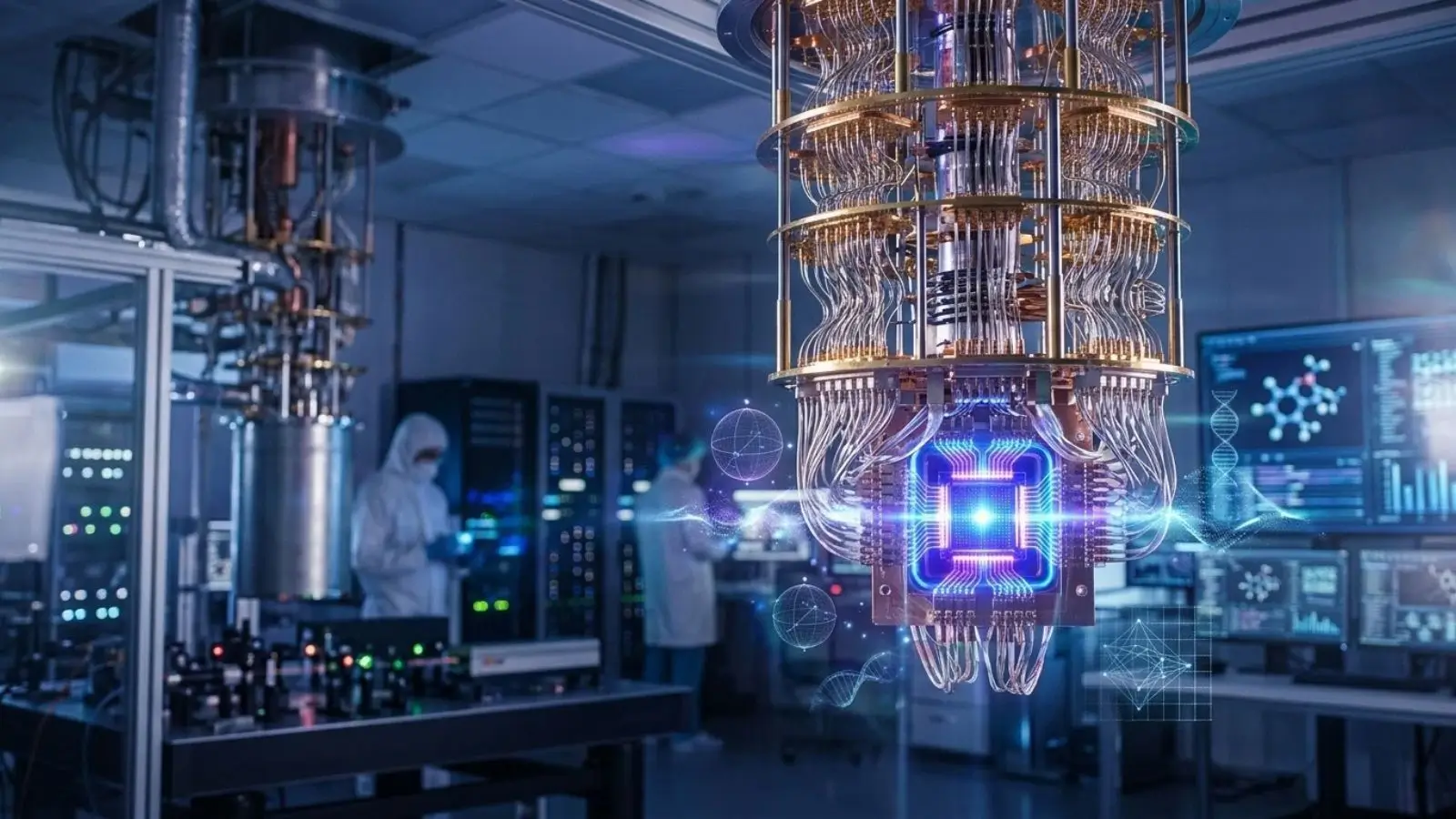
Quantum computing is an emerging field that could change how scientists solve some of the world’s most challenging problems.
From developing new medicines to designing advanced materials and improving scientific simulations, this technology offers possibilities that go beyond conventional computing in certain specialized tasks.
Unlike traditional computers, which process information using bits represented as 0s and 1s, quantum computers use quantum bits, commonly called qubits.
These rely on principles of quantum physics to represent and manipulate information in fundamentally different ways.
However, quantum computing is not simply a faster version of an ordinary computer.
Its potential advantages depend on the problem being solved, the algorithm being used, and the reliability of the hardware.
Understanding how it works, where it may be useful, and what challenges remain can help us see how quantum computing might shape future technology.
What Is Quantum Computing?
Quantum computing is a type of computation that uses principles of quantum mechanics to process information. Quantum mechanics describes the behavior of matter and energy at extremely small scales, including those of atoms and subatomic particles.
Traditional computers are excellent at everyday tasks such as running websites, editing documents, managing databases, and streaming videos.
Quantum computers are being developed for a different purpose: tackling certain specialized problems that may be extremely difficult for conventional machines.
For example, accurately modeling the quantum behavior of complex molecules can demand enormous computational resources.
A sufficiently capable quantum computer could help researchers study these systems in new ways.
Quantum computing is still an evolving technology. Researchers have demonstrated important capabilities, but building reliable, large scale machines that provide practical advantages across major real world problems remains a significant challenge. <Cite refs={[“turn592674search4″,”turn592674search6”]}/>
How Does Quantum Computing Work?
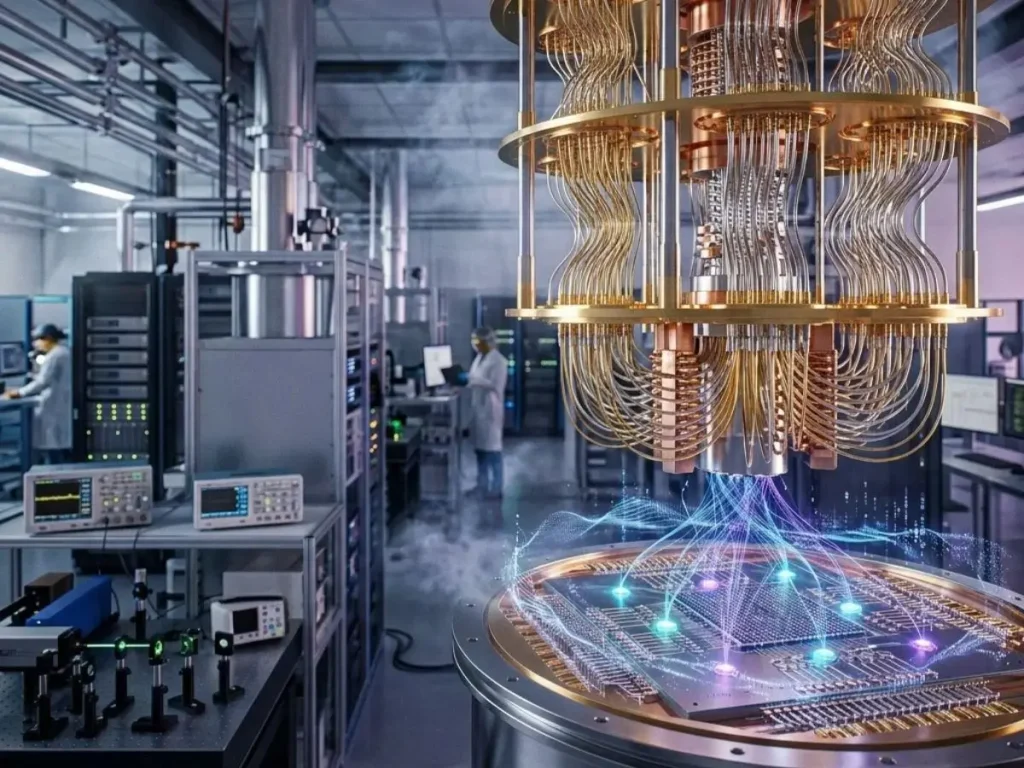
Quantum computers use qubits instead of relying exclusively on classical bits. Qubits can be built using different physical systems, including superconducting circuits, trapped ions, and other carefully controlled quantum systems.
The computer applies carefully designed operations to these qubits, changing their quantum states. Measurements then produce classical results that researchers or applications can use.
Unlike a conventional computer program, a quantum algorithm must be designed around the special rules of quantum mechanics. Simply having qubits does not automatically make a calculation faster.
Qubits, Superposition, and Entanglement
Qubits: A classical bit has a value of either 0 or 1.
A qubit can occupy a quantum state called a superposition, which combines the possibilities associated with these outcomes.
When measured, its result is recorded as a classical value.
Superposition: This property allows quantum systems to represent combinations of possible states. Quantum algorithms use these states in carefully controlled ways to solve particular computational problems.
lEntanglement: Two or more qubits can become entangled, meaning their combined quantum state cannot be described as independent states of each qubit. Entanglement is an important resource in many quantum algorithms.
Quantum interference: Quantum algorithms can make probability amplitudes reinforce or cancel one another. By designing operations carefully, an algorithm can increase the likelihood of useful answers and reduce the likelihood of unwanted ones.
These principles work together. Quantum computers do not simply test every possible answer and instantly reveal the correct one; successful algorithms must use quantum operations to extract useful information from the system. <Cite refs={[“turn592674search5″,”turn592674search6″,”turn592674search8”]}/>
Quantum Computers vs. Classical Computers
Classical computers use bits and conventional logic operations. They are reliable, versatile, affordable for many tasks, and essential to modern life.
Quantum computers use qubits and quantum operations. They may offer advantages for selected problems involving quantum simulations, certain mathematical calculations, and other specialized algorithms.
The differences can be summarized as follows:
| Feature | Classical Computers | Quantum Computers |
| Basic information unit | Bit | Qubit |
| Information processing | Classical logic operations | Quantum operations and measurement |
| Main strengths | Everyday computing, business software, and general purpose tasks | Potential advantages for selected specialized problems |
| Hardware requirements | Range from ordinary devices to supercomputers | Often require highly controlled physical environments |
| Error management | Mature techniques for reliable operation | Quantum errors remain a major engineering challenge |
| Current role | Widely used across nearly every industry | Research, experimentation, and selected early applications |
Quantum computers are not expected to replace ordinary computers. A more realistic future is a combination of classical systems and quantum processors, with each handling the tasks for which it is best suited.
Applications of Quantum Computing
The future impact of quantum computing depends on whether researchers can develop reliable machines and algorithms that outperform existing methods on useful tasks. Several fields are receiving particular attention.
Medicine and Drug Discovery
Developing a new medicine requires scientists to understand how molecules interact, how potential drugs bind to biological targets, and how chemical structures influence their behavior.
Quantum computers could eventually help simulate certain molecular systems more accurately or provide new approaches to studying chemical reactions. These capabilities might support early stage drug discovery and research into complex biological processes.
However, quantum computing will not automatically discover cures or replace laboratory experiments and clinical trials. Any potential benefit must be demonstrated through reliable research and compared with existing computational methods.
Cybersecurity and Encryption
Quantum computing has important implications for digital security. A sufficiently powerful, fault tolerant quantum computer could use certain algorithms to threaten widely used public key cryptographic systems, including RSA and elliptic curve cryptography.
This does not mean that all encryption would suddenly become useless. The impact would depend on the algorithm, the available quantum hardware, and the security system being used.
Researchers are developing post quantum cryptography, which uses mathematical methods designed to resist attacks from both conventional and quantum computers.
In 2024, the US National Institute of Standards and Technology finalized its first three principal post quantum cryptography standards, marking an important step toward preparing digital systems for future risks.
<Cite refs={[“turn592674search3″,”turn592674search9”]}/>
Materials Science and Advanced Manufacturing
Scientists continually search for materials that are lighter, stronger, more durable, or better at conducting electricity. Designing such materials often requires understanding the behavior of atoms and electrons.
Quantum computing may eventually help researchers model certain chemical and physical processes that are difficult to simulate accurately with conventional methods.
Possible areas of investigation include improved battery materials, specialized electronic components, catalysts, and materials for energy storage.
These applications remain dependent on technical progress. Quantum computers must deliver reliable results that offer a practical advantage over existing simulation tools before their impact can be established.
Energy and Climate Research
Energy systems involve complex processes, from chemical reactions in batteries to the behavior of materials used in solar cells and industrial catalysts.
Quantum computing could help researchers investigate some of these processes and explore materials that may improve energy efficiency. It may also contribute to research into chemical systems relevant to cleaner industrial production.
Climate modeling itself is a broad challenge involving the atmosphere, oceans, land, and human activity.
Quantum computing is not a proven replacement for today’s climate models, but specialized research may eventually contribute to particular scientific calculations.
Finance and Risk Analysis
Financial institutions evaluate risk, analyze portfolios, detect unusual activity, and make decisions under uncertainty. Some of these tasks involve complex mathematical optimization.
Researchers are investigating whether quantum algorithms could help with selected portfolio problems, scenario analysis, or other specialized calculations. However, many financial optimization problems are difficult for reasons that quantum hardware alone does not automatically solve.
Any proposed advantage must be tested against strong classical algorithms, including the computing methods already used by financial institutions. Practical adoption will depend on accuracy, cost, speed, and the value of the results.
Artificial Intelligence and Machine Learning
Artificial intelligence relies on algorithms that learn patterns from data. Quantum computing researchers are exploring whether quantum techniques could improve selected machine learning tasks or provide new ways to represent and process information.
Potential research areas include optimization, data analysis, and hybrid systems that combine classical machine learning with quantum processing.
Nevertheless, quantum computers are not automatically better at AI. Many current AI workloads are efficiently handled by classical processors and specialized hardware such as GPUs. Any quantum advantage must be demonstrated for a clearly defined task rather than assumed from the technology alone.
Logistics and Complex Optimization
Businesses often need to make decisions involving many connected variables. Examples include delivery routes, warehouse operations, production schedules, and supply chain planning.
Quantum algorithms may eventually help with some optimization problems, particularly when a suitable algorithm can exploit the structure of the problem.
Researchers are investigating different approaches, including methods that combine quantum and classical computing.
For now, conventional optimization software remains highly effective for many practical applications.
Quantum approaches must demonstrate better results, lower costs, or another measurable advantage before they can be considered superior.
How Quantum Computing May Shape the Future
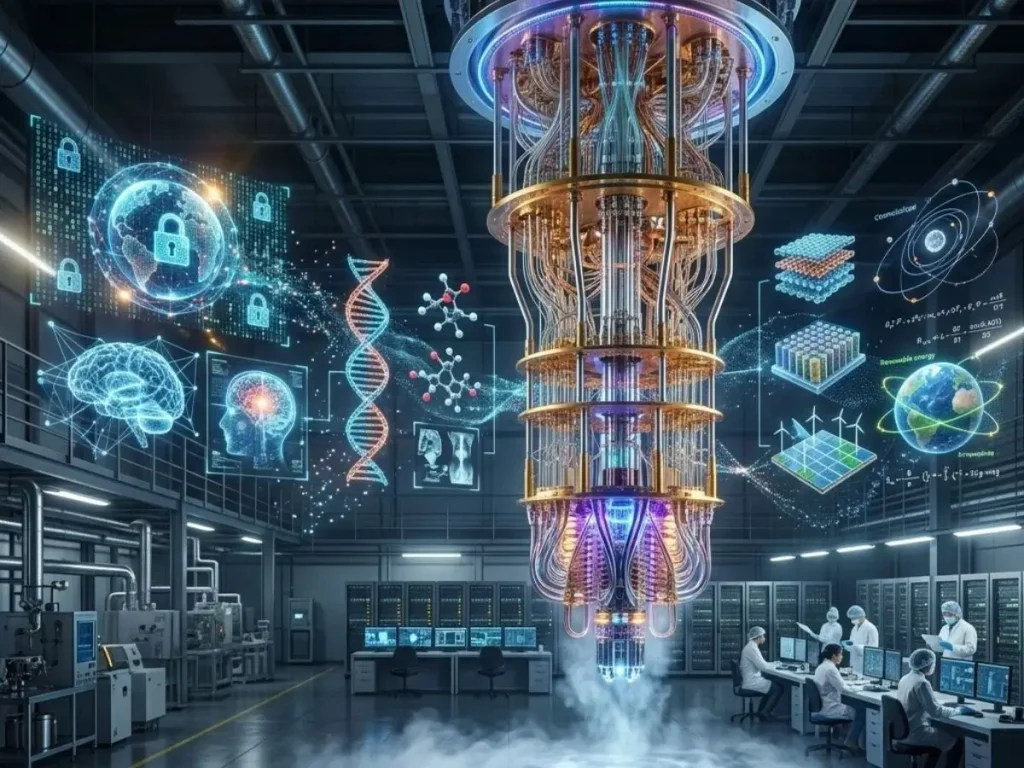
Quantum computing could influence future technology by giving researchers new tools for solving problems that are difficult to handle with existing computers.
Its impact will depend on scientific progress, practical costs, and the development of algorithms that produce measurable benefits.
More Advanced Scientific Discoveries
Future quantum computers may help scientists investigate molecular interactions, complex chemical reactions, and physical systems with greater detail.
These capabilities could support discoveries in medicine, materials science, and energy research.
Instead of relying entirely on approximations, researchers may eventually use quantum processors to study selected quantum systems more directly.
This could make certain experiments easier to plan and reduce the number of physical tests needed during early research.
Better Integration With Supercomputers
The future of computing is unlikely to depend on quantum machines alone. Classical computers will continue handling everyday applications, data processing, and many complex calculations.
A combined system could assign suitable tasks to a quantum processor while using conventional processors to prepare data, manage calculations, and analyze the results. This approach is often described as quantum centric or hybrid computing.
Such systems could be particularly useful when a problem contains a specific calculation that benefits from quantum methods but requires conventional computing for everything else.
New Opportunities for Businesses
As the technology matures, businesses may explore quantum computing for specialized research and development.
Pharmaceutical companies, chemical manufacturers, energy researchers, and financial institutions are among the organizations investigating potential applications.
However, practical adoption will depend on whether quantum solutions outperform established alternatives in cost, accuracy, speed, or another meaningful measure.
Not every business problem requires a quantum computer, and many applications may continue to rely on conventional systems.
Changes in Digital Security
Quantum computing could eventually change how digital information is protected.
This possibility is encouraging researchers and organizations to prepare for future cryptographic risks before powerful quantum machines become available.
Post quantum cryptography is an important part of this preparation. These methods are designed to protect information against attacks from both classical and quantum computers, allowing digital systems to prepare for technological changes without waiting for a major security threat to emerge. <Cite refs={[“turn592674search2″,”turn592674search3”]}/>
Challenges and Limitations of Quantum Computing
Despite its promise, quantum computing faces substantial scientific and engineering challenges. Understanding these limitations is essential for separating realistic opportunities from exaggerated predictions.
Qubits Are Sensitive to Their Environment
Qubits can be disturbed by environmental noise, unwanted interactions, and imperfections in the hardware. These disturbances may damage quantum information before a calculation is complete.
The loss of a carefully controlled quantum state is associated with a process called decoherence. Researchers use specialized hardware, control methods, and error management techniques to reduce its effects.
Quantum Error Correction Is Difficult
Quantum computations can produce errors during state preparation, operations, and measurement. Error correction aims to protect useful quantum information by encoding it across a larger system and detecting or correcting faults.
This process requires additional physical resources and careful engineering.
Building a machine with many physical qubits is not enough by itself; those qubits must also support sufficiently reliable operations to complete meaningful calculations.
Quantum Hardware Can Be Expensive
Some quantum computing technologies require extremely low temperatures, specialized electronics, vibration control, and carefully isolated environments.
Other approaches use different hardware and have their own engineering requirements.
These systems are more complicated than ordinary desktop computers, and their supporting infrastructure can be costly.
Researchers are working to improve reliability, simplify control systems, and make quantum hardware easier to scale.
Practical Quantum Advantage Is Problem Specific
A quantum computer may outperform classical machines on a particular task without offering an advantage for other tasks.
Researchers must compare quantum methods against the strongest available classical algorithms and consider the complete cost of running a calculation.
A convincing demonstration of quantum advantage requires more than a large qubit count or an impressive experimental result.
For many applications, conventional computers remain the more practical choice. <Cite refs={[“turn963143search0″,”turn963143search4”]}/>
Frequently Asked Questions
What is quantum computing in simple words?
Quantum computing is a way of processing information using principles of quantum physics. It uses qubits and specialized operations to tackle certain problems that may be difficult for conventional computers.
How is a quantum computer different from a normal computer?
A normal computer processes information using bits represented as 0s and 1s. A quantum computer uses qubits, which can occupy superposition states and become entangled.
These properties allow quantum algorithms to approach certain problems differently, but they do not make every calculation faster.
What are the main applications of quantum computing?
Potential applications include molecular simulation, materials research, chemical development, selected optimization problems, and research into new computing methods.
The practical benefits vary by application and are still being investigated.
Can quantum computers replace traditional computers?
No. Conventional computers are highly effective for everyday computing and most existing software. Quantum computers are expected to complement them by handling selected specialized tasks where quantum methods provide a demonstrable advantage.
Will quantum computing improve artificial intelligence?
It may eventually help with selected machine learning or optimization tasks. However, researchers have not established that quantum computers will outperform classical systems across AI applications generally.
Can quantum computers break passwords and encryption?
A sufficiently powerful, fault tolerant quantum computer could threaten certain widely used public key cryptographic systems.
If would not automatically break every password or every encryption method. Quantum cryptography is being developed to protect digital systems against these potential risks.
Are quantum computers available today?
Yes. Research institutions and technology companies operate quantum computing systems, and some provide access through cloud platforms.
However, current machines have limitations, and building reliable, large scale systems capable of delivering broad practical benefits remains a major challenge.
Why do quantum computers need special conditions?
Different quantum technologies have different requirements. Some need extremely low temperatures or precise control to protect fragile quantum states from environmental disturbances.
These conditions help reduce errors and improve the reliability of calculations.
Conclusion
Quantum computing represents an important development in modern science and technology.
By using qubits, superposition, entanglement, and quantum interference, researchers are exploring new ways to approach calculations that can be difficult for conventional computers.
Its potential applications include drug discovery, materials science, energy research, optimization, and cybersecurity.
At the same time, challenges involving hardware reliability, error correction, cost, and practical performance must be addressed before its wider impact becomes clear.
The most realistic future is one in which quantum computers work alongside classical computers rather than replace them.
As research advances, the technology may help scientists solve selected problems, develop new materials, and explore possibilities that are difficult to investigate with existing methods.
Understanding both the opportunities and limitations of quantum computing provides a clearer picture of how this emerging technology could shape future innovation.
Discover More Post
- Small Business Digital Growth: Smart Tips In (2026)
- Artificial Intelligence: The Future of Business (2026)
- Smarter Business Strategies for Bigger Growth (2026)?

I’m James Anderson, a curious researcher and writer who loves discovering interesting facts and exploring the stories behind them. I enjoy writing about history, science, culture, nature, geography, and the surprising details of everyday life. I aim to turn reliable information into simple, engaging content that helps readers learn something new and useful.
Books by James Anderson:
- The Fascinating World of Facts
- 1000 Things You Never Knew