

Cats have fascinated humans for thousands of years. From ancient temples to modern homes, these graceful animals have earned a reputation for being mysterious, intelligent, and independent. Yet, behind their calm expressions are remarkable abilities and behaviors that continue to surprise scientists and pet owners alike.
Whether you already share your home with a feline friend or simply admire these incredible animals, learning interesting facts about cats helps you appreciate how unique they truly are. Their history, biology, communication, and relationship with humans reveal a story that goes far beyond the familiar image of a cat curled up on a windowsill.
This guide explores their origins, evolution, and exactly 20 fascinating facts about cats, along with their cultural importance, modern impact, and answers to common questions.
Quick Facts About Cats
| Feature | Details |
| Scientific Name | Felis catus |
| Family | Felidae |
| Average Lifespan | 12–18 years (many live beyond 20 years) |
| Origin | Descended from the African wildcat |
| Domestication | Around 9,000–10,000 years ago |
| Diet | Obligate carnivore |
| Average Weight | 3–7 kg (varies by breed) |
| Number of Recognized Breeds | More than 70 |
| Vision | Excellent low-light vision |
| Hearing Range | Up to approximately 64 kHz |
| Global Population | Over 600 million domestic cats worldwide |
Background and Overview
Domestic cats belong to the feline family, which also includes lions, tigers, leopards, and cheetahs. Unlike their larger relatives, cats adapted to living alongside humans while keeping many of their natural hunting instincts.
Most experts believe domestic cats originated from the African wildcat. Early farming communities unintentionally attracted rodents by storing grain, which in turn attracted wildcats. Rather than being actively domesticated like dogs, cats gradually formed a mutually beneficial relationship with humans.
Today, cats are among the world’s most popular pets because they require relatively little maintenance, adapt well to indoor living, and develop strong bonds with their owners.
The History of Domestic Cats
The journey of cats from wild hunters to beloved companions spans thousands of years.
Around 9,000 years ago, agriculture spread across the Middle East. As grain stores attracted mice and rats, wildcats naturally moved closer to human settlements. Farmers appreciated their rodent-hunting skills, leading to a peaceful coexistence.
Ancient Egypt elevated cats to an extraordinary status. They were associated with protection, fertility, and good fortune. Harming a cat was considered a serious offense, and many cats were carefully mummified after death.
As trade routes expanded, sailors brought cats aboard ships to control rats. These voyages helped cats spread across Europe, Asia, and eventually the Americas.
Today, cats serve not only as pets but also as therapy animals, working cats on farms, and cherished members of millions of families worldwide.
20 Interesting Facts About Cats
1. Every Cat Has a Unique Nose Print
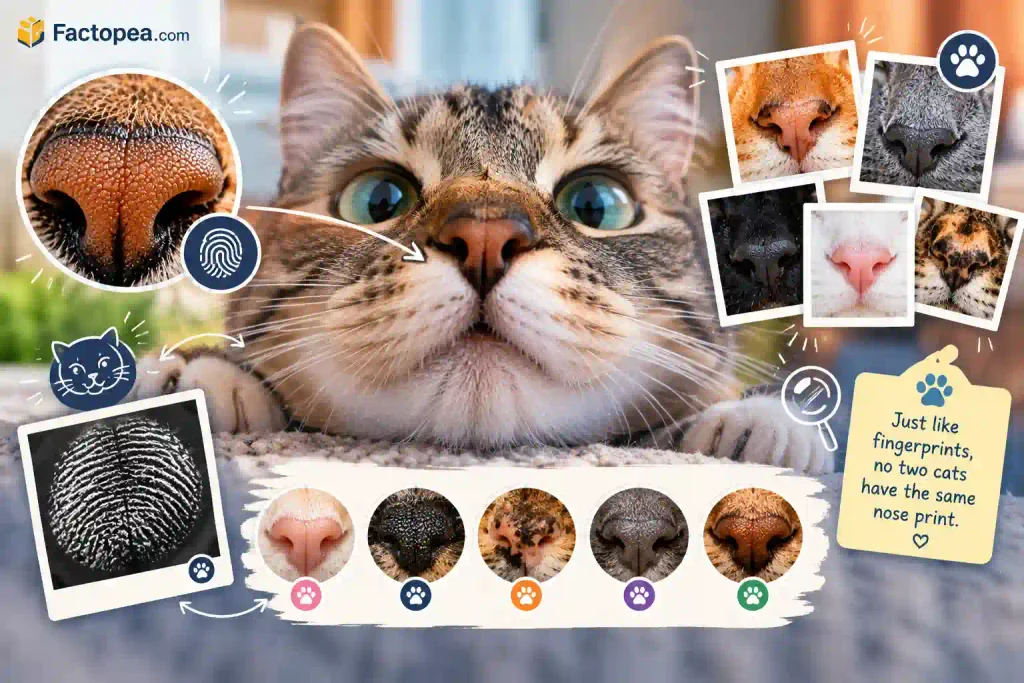
Just as human fingerprints are unique, every cat has a one-of-a-kind nose print. The tiny ridges and bumps never match another cat, making each feline biologically distinctive.
Although nose prints are not commonly used for identification, researchers recognize their uniqueness.
2. Cats Sleep for Most of the Day
Cats typically sleep between 12 and 16 hours daily, while kittens and senior cats may sleep even longer.
This behavior comes from their wild ancestors, who conserved energy between hunting sessions. Even indoor cats retain this natural rhythm despite having regular meals.
3. They Can Rotate Their Ears Almost Independently
A cat has more than 30 muscles controlling its ears.
These muscles allow each ear to rotate up to 180 degrees, helping cats pinpoint sounds with remarkable accuracy. They can even focus on different sounds simultaneously.
4. Cats Cannot Taste Sweet Foods
Unlike humans, cats lack the receptor needed to detect sweetness.
Because they are obligate carnivores, their bodies evolved to prioritize proteins and fats instead of sugary foods. This explains why many cats ignore cakes or candy.
5. Their Whiskers Are Precision Navigation Tools
Whiskers are deeply connected to sensitive nerve endings.
They help cats judge whether they can fit through narrow spaces, detect nearby objects in darkness, and sense subtle air movements that reveal obstacles or prey.
6. Cats Communicate Differently With Humans
Adult cats rarely meow at one another.
Instead, meowing developed mainly as a way to communicate with people. Many cats even create different meows to express hunger, greeting, or a desire for attention.
7. Purring Isn’t Always a Sign of Happiness
Although cats often purr when relaxed, they may also purr when frightened, injured, or recovering from illness.
Researchers believe purring may help reduce stress and possibly support healing through low-frequency vibrations.
8. Cats Are Excellent Jumpers
A healthy cat can jump about five to six times its body length.
Strong back legs, flexible joints, and exceptional balance allow them to leap onto shelves, fences, and trees with ease.
9. Their Night Vision Is Outstanding
Cats see much better than humans in dim lighting.
A reflective layer behind the retina, called the tapetum lucidum, improves their ability to detect movement in low-light conditions, making them effective nighttime hunters.
10. Cats Walk With Incredible Precision
When cats walk, their back paws usually land almost exactly where their front paws stepped.
This movement creates less noise, improves balance, and leaves a smaller trail, making stalking more effective.
11. They Spend Hours Grooming
Cats may spend nearly half of their waking hours grooming.
Besides keeping their fur clean, grooming helps regulate body temperature, remove loose hair, and spread natural skin oils throughout the coat.
12. Domestic Cats Still Share DNA With Big Cats
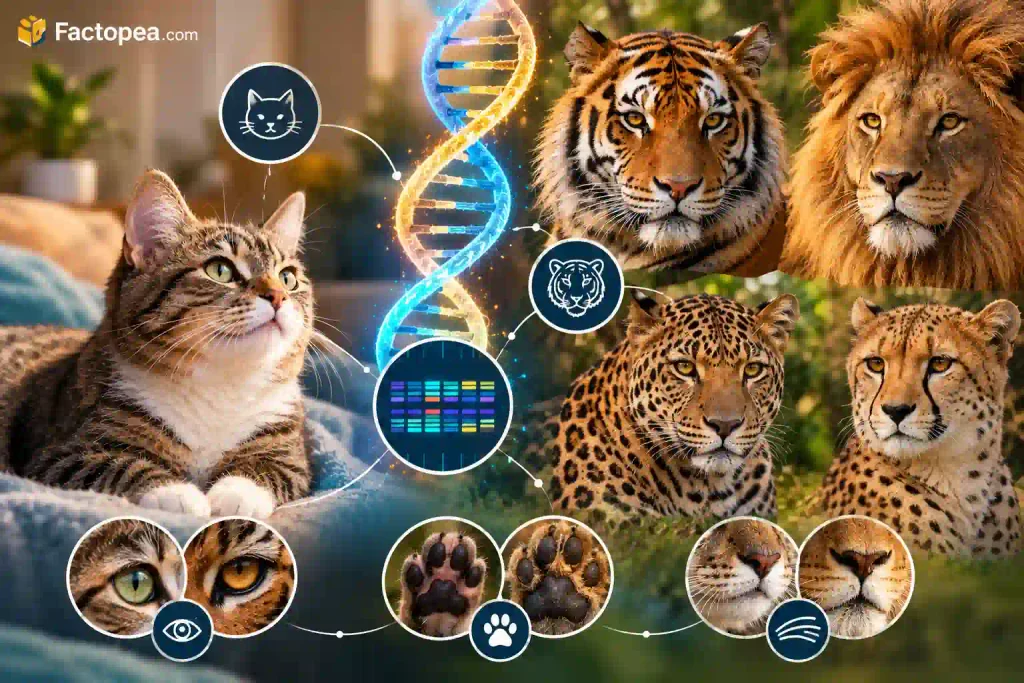
Modern cats share much of their genetic makeup with lions, tigers, and other wild felines.
Many instinctive behaviors—including stalking, pouncing, and scent marking remain remarkably similar despite thousands of years of domestication.
13. Cats Have Exceptional Hearing
Cats hear higher frequencies than both humans and dogs.
This ability helps them detect tiny rodents moving beneath leaves, snow, or grass long before people notice any sound.
14. Their Spine Is Extremely Flexible
A cat’s flexible spine allows dramatic stretching, twisting, and rapid acceleration.
Combined with powerful muscles, this flexibility explains their impressive agility during climbing and jumping.
15. Most Cats Prefer Running Water
Many cats enjoy drinking from moving water instead of still bowls.
Flowing water often stays cooler and fresher, and instinct may encourage cats to avoid stagnant water that could carry bacteria.
16. Cats Can Learn Hundreds of Words
Although they may appear selective, many cats recognize their names and numerous familiar words.
They often associate specific sounds with feeding times, favorite toys, or daily routines through repeated experience.
17. The Oldest Known Pet Cat Lived Thousands of Years Ago
Archaeologists discovered a human buried alongside a cat in Cyprus approximately 9,500 years ago.
The discovery suggests humans and cats formed close relationships even before ancient Egyptian civilization celebrated them.
18. A Cat’s Tail Is Essential for Balance
The tail acts like a counterweight while climbing, jumping, and making sharp turns.
Although cats can adapt if they lose part of their tail, a healthy tail greatly improves stability and coordination.
19. Some Cats Have More Than the Usual Number of Toes
Certain cats are born with extra toes, a condition known as polydactyly.
These cats often have unusually large paws that may provide extra grip while climbing or walking on uneven surfaces.
20. Cats Continue to Surprise Scientists
Modern research continues to reveal new insights into feline intelligence, memory, emotions, and communication.
Scientists are discovering that cats can recognize familiar voices, remember routines, solve simple problems, and form meaningful social relationships with both humans and other animals.
Cats in Culture and Traditions
Cats have appeared in myths, religions, folklore, and literature across civilizations.
Ancient Egyptians viewed them as symbols of protection and grace. In Japan, the famous beckoning cat, or Maneki-neko, is believed to bring prosperity and good luck. In parts of Europe, black cats have experienced both admiration and superstition throughout history.
Today, cats are internet celebrities, therapy companions, artistic inspirations, and beloved household pets in cultures around the globe.
Special Features That Make Cats Unique
Several biological adaptations set cats apart from many other domestic animals.
Their retractable claws remain sharp because they stay protected while walking. Their rough tongues contain tiny backward-facing structures that help remove dirt and loose fur during grooming. Flexible shoulders allow cats to squeeze through surprisingly narrow openings, while highly sensitive whiskers provide constant environmental feedback.
Together, these features make cats among nature’s most efficient small predators.
The Modern Importance of Cats

Cats play a significant role in modern society beyond companionship.
They help reduce loneliness for many owners, provide emotional comfort, and are increasingly included in animal-assisted therapy programs. Barn cats continue controlling rodent populations on farms, reducing the need for chemical pest control.
The pet care industry has also expanded rapidly, supporting veterinary medicine, nutrition research, pet insurance, technology, grooming, and animal welfare organizations.
As urban living grows, cats remain one of the most adaptable companion animals for apartments and smaller homes.
Frequently Asked Questions
Why are cats considered mysterious animals?
Cats display independent behavior, excellent night vision, quiet movement, and subtle communication, making them appear mysterious compared to many other pets.
What is the most interesting fact about cats?
One of the most surprising facts is that adult cats primarily meow to communicate with humans rather than with other cats.
Can cats recognize their owners?
Yes. Cats recognize familiar voices, scents, routines, and appearances, often forming strong emotional bonds with their owners.
Why do cats purr?
Cats usually purr when relaxed, but they may also purr when stressed, frightened, injured, or comforting themselves.
Are cats descended from wild animals?
Yes. Domestic cats evolved from the African wildcat and still retain many hunting instincts shared with their wild ancestors.
How long do domestic cats usually live?
Most domestic cats live between 12 and 18 years, although many reach their twenties with excellent care and regular veterinary attention.
Conclusion
Learning these interesting facts about cats reveals just how extraordinary these animals truly are. From their ancient partnership with humans to their remarkable senses, agile bodies, and fascinating behaviors, cats continue to capture our curiosity in ways few other animals can.
Whether you admire their intelligence, appreciate their companionship, or simply enjoy discovering unusual facts, understanding cats helps us value the unique role they play in homes and cultures around the world. As research continues to uncover new insights into feline behavior and cognition, there’s always something new to learn about these remarkable companions.

I’m William Parker, a content writer with a strong interest in facts, knowledge, and the stories behind the information we encounter every day. I enjoy researching topics that make people stop and think, especially unusual facts, history, science, technology, and human culture. I believe learning becomes much more enjoyable when information is presented in a simple and relatable way.
Books by William Parker:
- The Ultimate Book of Interesting Facts
- Inside the World of Knowledge