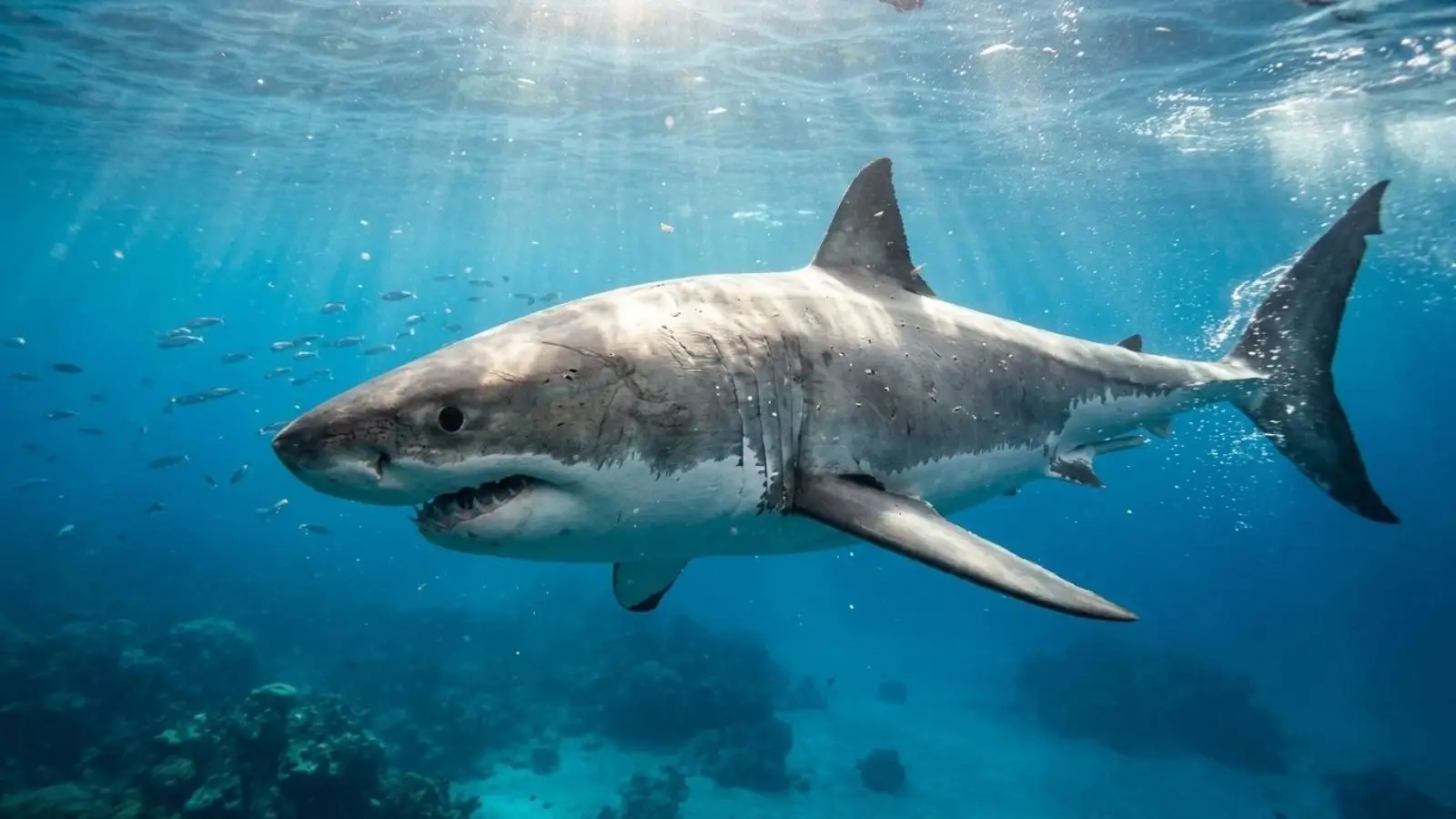
Sharks are among the most remarkable animals in the ocean. They have been swimming through Earth’s waters for hundreds of millions of years, adapting to environmental changes that transformed the planet. From the enormous whale shark to the tiny dwarf lanternshark, these fascinating fish come in a surprising variety of shapes, sizes, and lifestyles.
Learning interesting facts about sharks reveals a world far more complex than the frightening image often presented in movies. Some sharks are active hunters, while others feed by filtering tiny organisms from seawater. Certain species migrate across enormous distances, and others spend much of their lives in cold, dark deep sea environments.
Sharks also help maintain healthy marine ecosystems, making their survival important for ocean biodiversity. In this guide, we explore their evolutionary history, extraordinary senses, feeding habits, reproduction, famous species, and the challenges they face today.
Quick Facts About Sharks
| Feature | Details |
| Scientific group | Selachimorpha |
| Animal classification | Cartilaginous fish |
| Habitat | Marine environments worldwide; a few species enter freshwater |
| Number of species | More than 500 known species |
| Evolutionary history | Shark ancestors appeared over 400 million years ago |
| Largest species | Whale shark |
| Smallest known species | Dwarf lanternshark |
| Skeleton | Primarily cartilage |
| Diet | Varies from plankton and small fish to larger marine animals |
| Breathing | Through gills |
| Reproduction | Varies by species; includes egg laying and live birth |
| Major threats | Overfishing, accidental capture, habitat degradation, and climate change |
Shark Background and Overview
Sharks are fish belonging to a group called cartilaginous fishes. Unlike most familiar bony fish, their skeletons consist mainly of cartilage, the flexible tissue also found in human noses and ears.
This does not mean sharks have weak bodies. Their cartilage is supported by connective tissues, and their skin contains tiny tooth like structures that provide protection and influence how water flows around them.
Sharks inhabit a wide range of marine environments. Some patrol warm coral reefs and coastal waters, while others live in the open ocean or descend into deep, cold habitats. A few species, including bull sharks, can also tolerate freshwater for periods of time.
Their diets are equally varied. Depending on the species, sharks may eat plankton, squid, crabs, fish, sea turtles, or marine mammals. Their different feeding strategies help them occupy distinct roles in the marine food web.
Although shark attacks receive considerable attention, most shark species are not considered dangerous to humans. Sharks generally do not seek people as prey, and encounters are uncommon for most people who visit the ocean.
The Evolution and History of Sharks
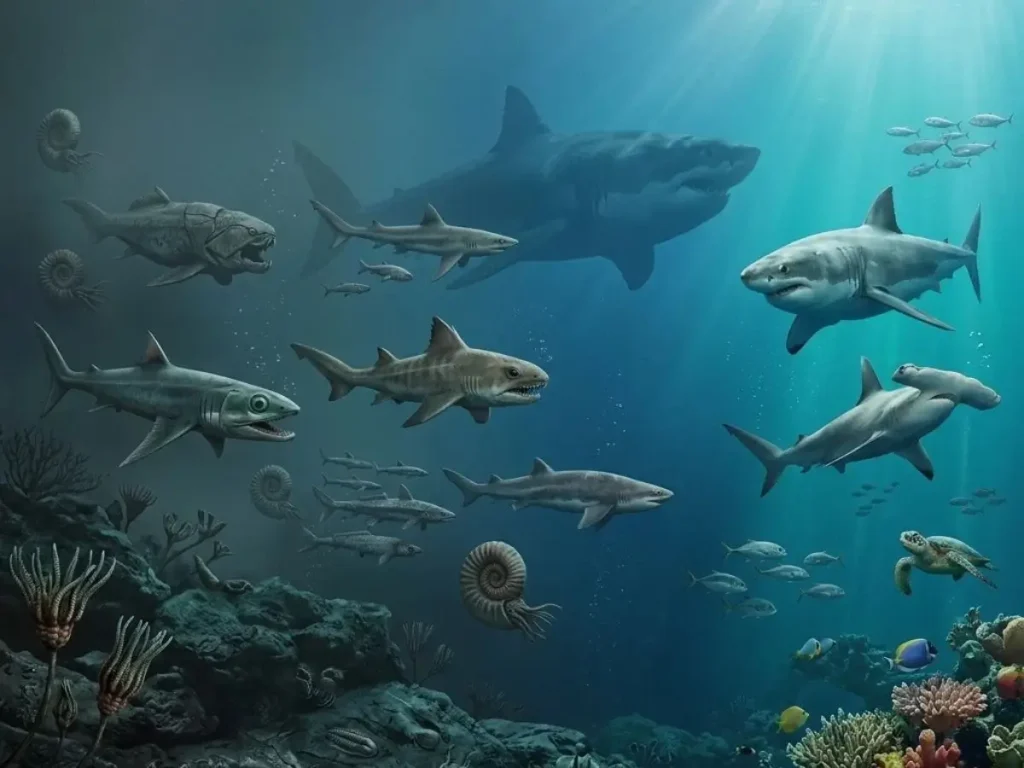
Sharks have an extraordinary evolutionary history. Fossil evidence shows that shark ancestors were present in ancient seas more than 400 million years ago, long before dinosaurs appeared.
Understanding their past is challenging because cartilage does not fossilize as readily as bone. Consequently, many discoveries come from fossilized teeth, microscopic skin structures called denticles, and occasional vertebral remains.
Ancient shark relatives did not all resemble the sharks we recognize today. Some had unusual body shapes, distinctive fin structures, or specialized teeth. Over geological time, different lineages developed adaptations that allowed them to exploit new food sources and habitats.
Sharks also survived major environmental upheavals, including mass extinction events. However, today’s sharks are not unchanged relics of the past. Modern species have continued evolving, and their diversity reflects millions of years of adaptation.
One important difference between ancient and modern threats is the speed at which humans can affect shark populations. Commercial fishing and accidental capture can remove animals faster than slow growing species are able to replace them.
20 Interesting Facts About Sharks
1. Sharks Are Older Than Dinosaurs
Sharks have a much longer evolutionary history than dinosaurs. Shark ancestors appeared more than 400 million years ago, whereas the earliest dinosaurs emerged roughly 230 million years ago.
This means shark lineages were already developing in ancient oceans long before dinosaurs walked on land. Their evolutionary history includes dramatic changes in climate, sea levels, and marine ecosystems.
However, modern sharks are not identical to their ancient relatives. They represent the surviving branches of a diverse group that has changed considerably over time.
2. Not Every Shark Is a Dangerous Hunter
Sharks are often portrayed as aggressive predators, but their feeding habits differ enormously.
The whale shark, for example, feeds mainly on plankton and other small organisms. Basking sharks also filter tiny food particles from seawater, while many smaller sharks eat crustaceans, mollusks, and modest sized fish.
Even among predatory species, behavior depends on factors such as age, habitat, available food, and environmental conditions. It is inaccurate to assume that every shark hunts large animals or poses the same level of risk to people.
3. Shark Skeletons Are Made Mainly of Cartilage
A shark’s skeleton is made primarily of cartilage rather than bone. Cartilage is relatively light and flexible, helping support the body without the weight of a fully bony skeleton.
This structure is particularly useful for swimming, although cartilage alone does not explain every aspect of shark movement. Muscle strength, fin shape, body proportions, and swimming behavior all contribute to performance.
Despite their cartilage skeletons, sharks have hard teeth made from mineralized tissues. These teeth are among the most commonly discovered shark fossils because they preserve better than much of the rest of the body.
4. Shark Skin Is Covered in Tiny Tooth Like Structures
Shark skin contains microscopic structures called dermal denticles, also known as placoid scales.
These structures resemble tiny teeth and point backward along the body. Their arrangement makes the skin feel rough when rubbed against their direction.
Dermal denticles protect the skin and influence the flow of water around the shark. Scientists and engineers have studied these structures to understand fluid movement and develop surface designs inspired by nature.
However, shark skin is not a magical speed booster. Swimming performance depends on the entire body, including its shape, muscles, fins, and movement.
5. Sharks Continuously Replace Their Teeth
Unlike humans, most sharks have several rows of teeth, including replacement teeth behind those at the front of the jaw.
When a tooth breaks, wears down, or falls out, another may move forward to take its place. The rate of replacement varies by species, age, diet, and tooth position.
This arrangement is particularly valuable for animals that capture struggling prey or bite into hard food. Rather than depending on a single permanent set, many sharks have a continuing supply of replacement teeth.
Their teeth also reveal clues about their diets. Sharp, pointed teeth are useful for gripping prey, while broader teeth can help some species crush hard shelled animals.
6. The Whale Shark Is the World’s Largest Fish
The whale shark is the largest living fish, with exceptional individuals reaching around 40 feet or more. Its enormous body can appear intimidating, but its main food sources include plankton, fish eggs, and small schooling animals.
Whale sharks feed by taking in seawater and filtering out suitable food. They are found in tropical and warm temperate seas, although their movements depend on food availability and environmental conditions.
Their size does not make them invulnerable. Collisions with vessels, fishing pressure, and disturbance at feeding sites can threaten these gentle giants.
7. Some Deep Sea Sharks Produce Their Own Light
Several deep sea shark species are bioluminescent, meaning they can produce light through specialized biological processes.
The kitefin shark and certain lanternsharks are examples. Their light producing structures can help with camouflage, communication, or other functions, depending on the species.
In some environments, light from above creates a silhouette that predators below can see. Producing light along the underside may help a shark blend into the faint illumination coming from the surface.
Not every deep sea shark glows, and scientists are still investigating the precise functions of bioluminescence in different species.
8. Sharks Have an Extraordinary Range of Senses
Sharks use several senses together to locate food and navigate their surroundings. Their abilities include smell, vision, hearing, and detecting vibrations in the water.
One especially remarkable adaptation is the ampullae of Lorenzini. These sensory organs detect weak electrical fields produced by living animals. This can help a shark locate prey hidden beneath sand or close to its body.
Sharks also possess a lateral line system that detects water movements and vibrations. It provides useful information about nearby animals, even when visibility is poor.
No single sense makes sharks all powerful hunters. Their success comes from combining different forms of sensory information with experience and species specific behavior.
9. Greenland Sharks May Live for Centuries
The Greenland shark is famous for its exceptionally long estimated lifespan. Scientists have used radiocarbon analysis of eye lens tissue to estimate the ages of these slow growing Arctic and North Atlantic sharks.
One major study suggested that the largest individuals could be several centuries old, with estimates extending beyond 400 years. These figures carry substantial uncertainty, so they should not be treated as exact ages for every Greenland shark.
The species grows slowly and may take well over a century to reach sexual maturity. This makes it particularly vulnerable to fishing pressure because populations may need many decades to recover.
10. Some Sharks Can Rest on the Seafloor
The popular claim that all sharks must swim constantly to stay alive is incorrect.
Some species rely heavily on forward movement to push water across their gills. Others can pump water over their gills while resting, allowing them to remain relatively still on the seafloor.
Nurse sharks are a familiar example of sharks that can rest in this way. Their behavior demonstrates that sharks have evolved different breathing strategies suited to their environments.
Resting does not necessarily mean sleeping in the same way humans do. Scientists study shark activity and periods of reduced movement to better understand how different species rest.
11. Sharks Help Shape Marine Food Webs
Sharks can influence marine ecosystems through their roles as predators, scavengers, and consumers of different prey.
Some large predators affect where prey animals feed or how they move. Smaller shark species also contribute to food webs by consuming fish, shellfish, and other organisms.
The ecological effects of sharks vary by habitat and species. It is too simplistic to say that every shark directly improves coral reefs or fisheries, but losing important shark populations can disrupt relationships within marine communities.
Protecting sharks is therefore part of maintaining healthy and diverse ocean ecosystems.
12. Sharks Reproduce in Several Different Ways
Shark reproduction is more varied than many people realize. Some species lay eggs, while others retain developing embryos inside the mother and give birth to live young.
Egg laying species may produce tough, protective egg cases commonly called mermaid’s purses. These can attach to seaweed or rest among rocks, depending on the species.
In some sharks, embryos develop inside the mother and receive nourishment from a yolk sac. Other species have more complex arrangements, including nourishment supplied through structures that function somewhat like a placenta.
The number of pups also varies considerably. Some sharks produce only a small number of young at a time, which can make population recovery slow when adults are removed by fishing.
13. Hammerhead Sharks Have Distinctive Heads
Hammerhead sharks are instantly recognizable because their heads extend sideways into a flattened shape.
This structure places their eyes and sensory organs across a wider area. It may improve their ability to scan the surroundings and detect prey, including rays that hide near the seafloor.
Hammerhead species differ in size and behavior, so the advantages of their head shape are not necessarily identical across the group.
Several hammerhead species face serious conservation concerns because of fishing pressure and their vulnerability to capture.
14. Shark Encounters Do Not Usually Mean Humans Are Prey
Sharks do not normally target humans as a regular food source. Many species have diets that consist primarily of fish, squid, or other marine animals.
Nevertheless, shark bites can occur, sometimes with severe consequences. Researchers consider several possible explanations for individual incidents, including investigation, defensive behavior, and mistaken identification in certain circumstances.
It is not possible to determine the motive behind every encounter, and the phrase “sharks never mistake humans for food” would be too absolute.
People can reduce risk by following local beach warnings, staying out of areas closed because of shark activity, avoiding swimming near active fishing, and following lifeguard advice.
15. The Dwarf Lanternshark Is Remarkably Small
The dwarf lanternshark is one of the smallest known shark species, reaching only around 8 inches in length.
It inhabits deep waters and is rarely encountered by the public. Like other lanternsharks, it has specialized adaptations for life in the ocean’s darker environments.
Its tiny size highlights the enormous diversity of sharks. The group includes species that fit in the palm of a hand as well as animals weighing many tonnes.
Small sharks are still predators in their own ecological communities, and their importance should not be judged by their size alone.
16. Sharks Can Detect Blood Related Chemical Signals, but Not Magically From Miles Away
A shark’s sense of smell can be highly sensitive, allowing it to detect certain chemicals carried through water.
However, the popular idea that a shark can automatically smell a single drop of blood from miles away is misleading. Detection depends on the chemical concentration, water movement, distance, and the species’ sensory abilities.
A scent must reach the shark through the water before it can be detected. Ocean currents can carry chemical signals over a distance, but this does not mean every shark can follow every scent across an enormous area.
Smell is only one part of the hunting process. Sharks also use vision, vibrations, and electrical sensing, depending on the circumstances.
17. Some Sharks Make Long Distance Migrations
Certain shark species travel hundreds or thousands of miles between feeding grounds, breeding areas, and seasonal habitats.
Whale sharks, great white sharks, and several other migratory species can undertake extensive journeys. Their routes may change with water temperature, food availability, reproductive needs, and ocean conditions.
Researchers track these movements using tagging, satellite technology, and other monitoring methods. Such information helps identify important migration corridors and areas where sharks may be at risk from fishing.
Because sharks cross national boundaries and international waters, effective conservation often requires cooperation between countries.
18. Shark Pups Usually Receive Little Parental Care
Most sharks do not raise their young in the way mammals care for their offspring.
Depending on the species, pups hatch from egg cases or are born live. After birth or hatching, they generally must find food and avoid predators without continued care from their mother.
Newborn sharks are not necessarily skilled hunters from the first moment, but they possess the basic abilities needed to begin life independently.
Nursery habitats can be especially important. Shallow coastal areas, mangroves, seagrass beds, and other protected environments provide some young sharks with food and shelter.
Damage to these habitats can therefore affect shark populations long before individuals reach adulthood.
19. Shark Biology Inspires Scientific Research and Technology
Sharks have inspired researchers interested in efficient movement, surface structures, sensory systems, and marine engineering.
Their dermal denticles have been studied to understand how surface texture influences water flow. Researchers have also investigated shark inspired materials for potential applications in engineering and medical environments.
However, not every product described as “shark inspired” has been proven to improve performance in real world conditions. The benefits depend on the design and its intended use.
Studying sharks also contributes to broader biological research, including the evolution of sensory systems, reproductive strategies, and adaptation to extreme environments.
20. Many Shark Species Need Urgent Conservation Action
Despite their long evolutionary history, many sharks face serious threats from human activities.
Overfishing is a major concern. Sharks may be targeted for their meat, fins, liver oil, and other products, or caught unintentionally in fishing gear intended for other species. The latter is known as bycatch.
Their slow growth, late maturity, and relatively low reproductive output make recovery difficult for many species. Damage to coastal habitats and changes in ocean conditions can add further pressure.
A 2024 global assessment by the International Union for Conservation of Nature’s shark specialist group reported that more than one third of sharks, rays, and chimaeras were threatened with extinction. This figure covers all three groups, not sharks alone.
Protecting critical habitats, improving fisheries management, reducing accidental capture, and enforcing conservation rules are essential steps toward helping vulnerable populations recover.
Shark Diversity and Special Adaptations
Sharks are not a single type of hunter. Their body shapes and biological features reflect the environments in which they live.
Some species have powerful tails suited to active swimming. Others have flattened bodies that help them hide on the seafloor. Deep sea species may possess light producing organs, while filter feeding sharks have structures adapted to collecting tiny organisms from water.
Their senses are similarly diverse. Electrical sensing can help detect nearby animals, the lateral line registers water movement, and smell can provide information about chemical signals.
These adaptations work together rather than operating in isolation. A shark’s feeding strategy, swimming ability, and habitat preferences all influence how it survives.
Famous Shark Species Around the World
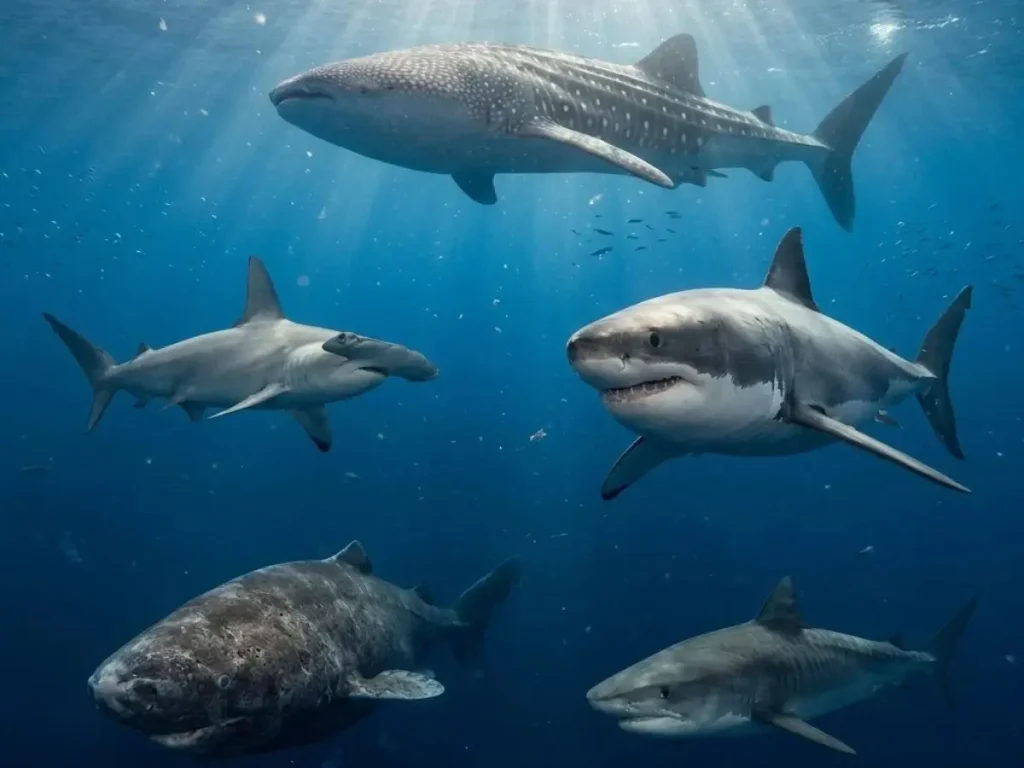
Great White Shark
The great white shark is a large marine predator found in several temperate and subtropical regions. Its diet can include fish, squid, and marine mammals, depending on age and location. Its powerful jaws and streamlined body make it an effective hunter.
Whale Shark
The whale shark is the largest living fish. It feeds mainly on plankton and other small organisms, making it a striking example of a very large animal that does not hunt large prey.
Hammerhead Shark
Hammerheads are known for their distinctive head shape and varied sensory adaptations. Different species occupy different habitats, and some feed on rays and other animals near the ocean floor.
Tiger Shark
Tiger sharks are opportunistic predators with a broad diet. They inhabit tropical and subtropical waters and may consume a wide range of marine animals, depending on what is available.
Greenland Shark
This slow growing shark inhabits cold North Atlantic and Arctic waters. Its remarkable estimated lifespan and late maturity make it especially important for long term conservation research.
Basking Shark
The basking shark is another enormous filter feeder. It often swims with its mouth open as it filters small organisms from seawater, illustrating how differently sharks can obtain food.
Why Sharks Matter in Modern Oceans
Sharks contribute to marine ecosystems in several ways. Predatory species can influence prey populations, while other sharks feed on smaller organisms and become part of broader food webs.
Their movements also connect different habitats. Migrating sharks may transport nutrients between feeding areas, while their presence can reveal information about the health and changing conditions of marine environments.
Sharks are valuable to scientific research because they provide opportunities to study evolution, sensory biology, reproduction, migration, and adaptation. Some coastal communities also benefit from responsible shark tourism, particularly where visitors support local businesses and conservation programs.
These benefits are not identical everywhere. The ecological role of a shark depends on its species and habitat, and sustainable management must account for local conditions.
Shark Conservation Challenges
Shark conservation is difficult because many species grow slowly and reproduce at relatively low rates. When fishing removes adults faster than populations can replace them, recovery may take decades or longer.
Overfishing and Bycatch
Sharks may be deliberately caught for commercial products or accidentally trapped in nets and on fishing lines. Better fishing practices, science based catch limits, monitoring, and enforcement can help reduce these losses.
Habitat Degradation
Coastal development, pollution, and the destruction of nursery habitats can affect young sharks and the prey they depend on. Protecting important coastal ecosystems can help safeguard multiple marine species at once.
Climate Change
Changing ocean temperatures, currents, and oxygen levels can influence where sharks find food and suitable habitat. These changes may also affect migration patterns and the availability of nursery areas.
What Can People Do?
Individuals can support shark conservation by learning about threatened species, choosing responsibly sourced seafood where reliable information is available, respecting marine wildlife, and supporting credible conservation efforts.
Divers and snorkelers should follow local guidance and avoid touching, chasing, or feeding sharks. Responsible wildlife observation protects both people and animals.
Conservation also requires effective laws, scientific monitoring, international cooperation, and action from fishing industries and governments. Individual choices can help, but long term progress depends on broader management measures as well.
FAQS
Why are sharks important to the ocean?
Sharks are part of marine food webs and can influence the populations and behavior of other animals. Their ecological roles vary by species, but protecting shark diversity helps maintain healthy and resilient ocean ecosystems.
What is the largest shark in the world?
The whale shark is the largest living shark and the largest fish. Exceptional individuals can reach around 40 feet or more, although many are smaller.
How many shark species are there?
Scientists have identified more than 500 shark species. The total may change as researchers discover new species and revise scientific classifications.
Are sharks dangerous to humans?
Most shark species are not considered dangerous to humans, and serious encounters are uncommon. However, some species can cause severe injuries, so following beach warnings and local safety advice is important.
Which shark lives the longest?
The Greenland shark is considered one of the longest living vertebrates. Scientific estimates suggest some individuals may survive for several centuries, although exact ages remain uncertain.
Do sharks sleep?
Sharks have periods of rest or reduced activity, but their resting patterns differ among species. Some can rest on the seafloor, while others need to keep moving to maintain water flow over their gills.
Can sharks smell blood from miles away?
Not in the unlimited way popular myths suggest. Sharks can detect certain chemicals in water, but their ability to find a scent depends on its concentration, water movement, distance, and the species involved.
Do all sharks have to swim continuously?
No. Some sharks rely on swimming to move water over their gills, while others can actively pump water across their gills while resting.
Do sharks lay eggs or give birth to live young?
Both methods occur. Some species lay protective egg cases, while others give birth to live pups. Reproductive strategies vary considerably across shark species.
Are whale sharks dangerous?
Whale sharks are filter feeders that mainly consume small organisms. They are generally considered gentle, but their enormous size means swimmers and divers should maintain a respectful distance and follow wildlife viewing guidelines.
Conclusion
The most interesting facts about sharks reveal animals that are far more diverse and complex than their popular reputation suggests. Their ancient evolutionary history, replaceable teeth, unusual sensory systems, varied diets, and remarkable lifespans make them among the ocean’s most fascinating inhabitants.
From tiny lantern sharks in deep water to enormous whale sharks filtering plankton near the surface, each species has adaptations suited to its environment. Sharks also contribute to marine food webs and provide valuable opportunities for scientific research.
Yet their long history does not guarantee their future. Overfishing, bycatch, habitat damage, and changing ocean conditions threaten many populations. Understanding sharks helps replace exaggerated fears with informed respect and shows why protecting these animals is an important part of protecting the world’s oceans.
Discover More Post
- 25 Interesting Facts About Dogs Explained For You
- 28 Interesting Facts About Koalas: Cool, Fun, and Weird Facts
- 28 Interesting Facts About Jaguars, Habitat & History (2026)

I’m Grace Anderson, a lifelong learner and writer with a habit of asking, “Why?” I love discovering the stories, facts, meanings, and explanations hiding behind ordinary questions. At Factopea, I turn my research into clear articles that readers can enjoy without needing complicated terminology. I believe learning does not always have to feel like studying—it can simply begin with one interesting question.
Books: Curiosity Has an Answer and Things You Never Noticed
2 thoughts on “20 Interesting Facts About Sharks Size, Senses & Survival”