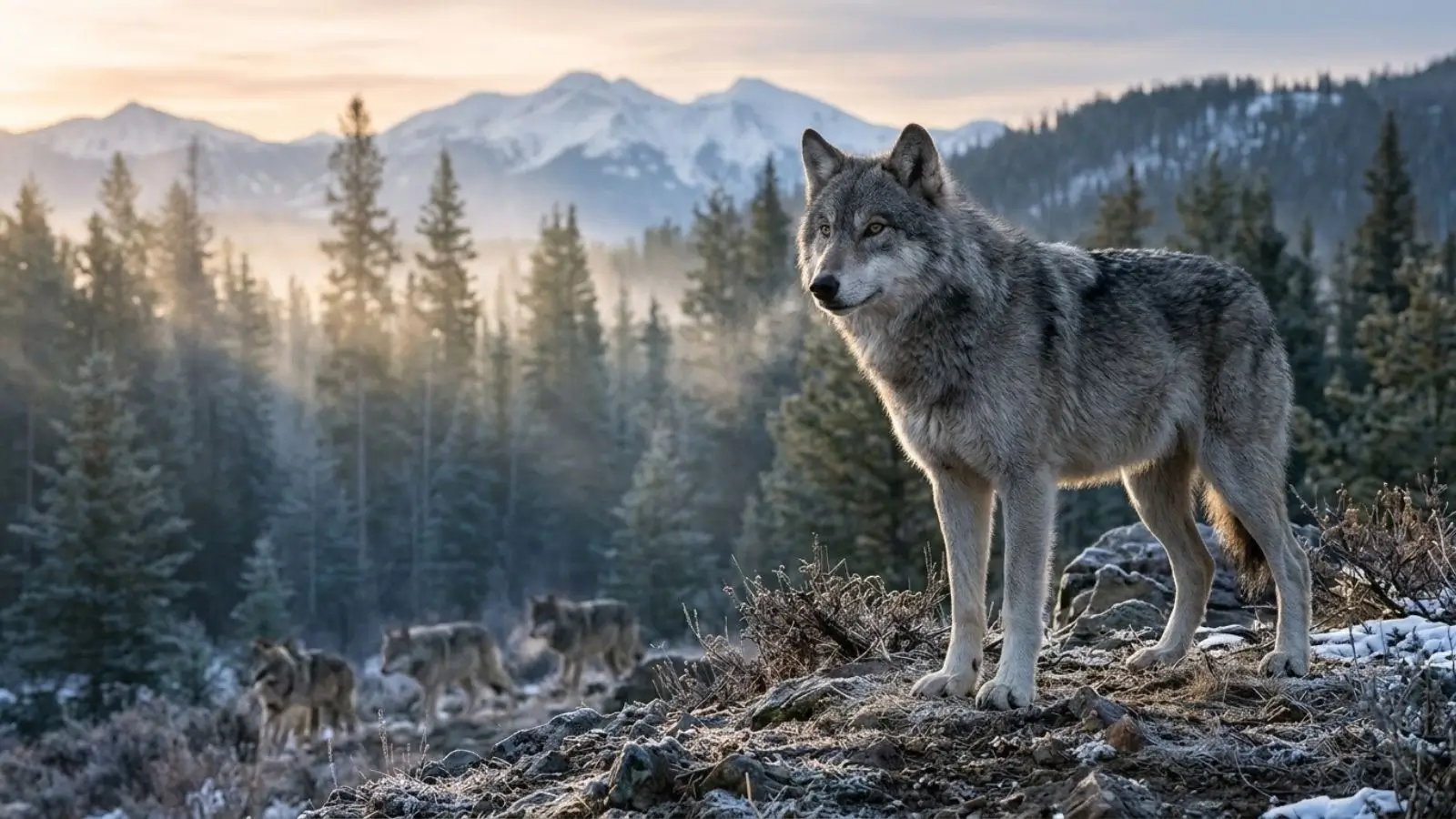
Wolves are among the most fascinating animals in the wild. Known for their intelligence, teamwork, and haunting howls, these powerful predators have captured human imagination for thousands of years.
Some people see wolves as symbols of loyalty and freedom, while others associate them with danger and mystery. But the truth about wolves is even more interesting than the stories told about them.
From their close family bonds to their remarkable hunting skills, wolves have developed extraordinary ways to survive in challenging environments.
They can travel long distances in search of food, communicate through sounds and scent, and raise their young with help from other pack members.
They also play an important role in maintaining healthy ecosystems by influencing prey populations and the behavior of other animals.
Wolves inhabit forests, mountains, grasslands, tundra, and other landscapes across parts of North America, Europe, and Asia.
Their ability to adapt to different environments has made them one of the most successful wild members of the dog family.
In this guide, you’ll discover interesting facts about wolves, including their history, behavior, physical adaptations, family life, and importance to nature.
These remarkable discoveries will help you understand why wolves deserve both our respect and our attention.
Quick Facts About Wolves
| Feature | Details |
| Common Name | Gray Wolf |
| Scientific Name | Canis lupus |
| Animal Family | Canidae |
| Animal Group | Mammals |
| Diet | Carnivore |
| Natural Distribution | Parts of North America, Europe, and Asia |
| Common Habitats | Forests, tundra, mountains, grasslands, and some arid regions |
| Average Lifespan | Often around 6–8 years in the wild, although some live longer |
| Largest Living Wild Canid | Gray Wolf |
| Typical Social Structure | Family based packs |
| Main Prey | Deer, elk, moose, caribou, and smaller animals, depending on location |
| Top Speed | Brief bursts can reach approximately 60 km/h (37 mph) |
| Main Communication Methods | Howling, scent marking, body language, and vocalizations |
| Main Ecological Role | Helps regulate prey populations and influence food webs |
| Conservation Status | Gray wolves are globally classified as Least Concern, but regional populations vary |
Wolf History, Habitat, and Remarkable Adaptations
Wolves have a long evolutionary history and a complicated relationship with humans. Understanding where they came from, how they survive, and why they matter helps explain their place in the natural world.
The History of Wolves and Their Connection With Dogs
Gray wolves belong to the dog family, Canidae, and are closely related to domestic dogs. Dogs descended from ancient wolf populations through a long process of domestication, although researchers continue to investigate exactly when and where this process began.
The relationship between wolves and humans goes back thousands of years. Early human communities may have competed with wolves for prey, while other interactions gradually helped shape the relationship that eventually led to domesticated dogs.
Across different cultures, wolves have represented strength, courage, wisdom, loyalty, and danger.
They appear in Indigenous traditions, European folklore, and ancient mythology. These stories have influenced how people view wolves, sometimes celebrating them and sometimes portraying them unfairly as villains.
In more recent history, widespread hunting and habitat changes caused wolf populations to decline in many regions.
Conservation measures, legal protections, and reintroduction programs have helped some populations recover, although wolves still face challenges in parts of their range.
Where Do Wolves Live?
Wolves are highly adaptable animals that occupy a wide range of environments. Their habitat depends on the subspecies, prey availability, climate, and level of human disturbance.
Gray wolves can be found in parts of Canada, Alaska, the contiguous United States, Europe, Russia, and Asia.
Some populations live in snowy northern landscapes, while others inhabit forests, mountains, grasslands, and comparatively dry regions.
Wolves need more than a place to hide. They require enough food, access to suitable territory, and opportunities to raise their pups.
Areas with abundant prey and relatively low human disturbance can be especially important for their survival.
How Wolves Survive in the Wild
Wolves have several physical features that make them effective travelers and hunters. Their long legs help them cover large distances, while their broad paws provide support on snow and uneven ground.
Their thick double layered coats offer insulation in cold weather. A dense undercoat traps warmth, while longer outer hairs help protect against moisture and environmental conditions. Fur thickness varies with climate and season.
Wolves also possess powerful jaws, sharp teeth, and keen senses. Their hearing helps them detect sounds, while their strong sense of smell allows them to follow scent trails and recognize other animals.
These adaptations work together to help wolves find food, avoid danger, and survive in changing environments.
20 Interesting Facts About Wolves
1. Wolves Usually Live in Family Based Packs
A wolf pack is commonly a family group rather than a collection of unrelated animals competing for dominance. It often includes a breeding pair and their offspring from one or more years.
Family members cooperate in hunting, protecting territory, and raising pups. Older offspring may help care for younger siblings before eventually leaving to find mates and establish territories of their own.
Pack size varies with food availability, habitat, and local circumstances. Some packs are relatively small, while others may contain more than ten wolves.
2. Wolves Communicate Through More Than Howling
Howling is one of the best known wolf behaviors, but it is only one part of their communication system. Wolves also use growls, whines, scent marking, facial expressions, ear positions, and body posture.
These signals help wolves communicate their intentions, maintain social relationships, warn rivals, and coordinate activities. A lowered body or tucked tail, for example, can communicate submission or uncertainty in particular social situations.
Scent marking is especially useful because it leaves information in the environment even when a wolf is no longer present.
3. A Wolf’s Howl Can Carry Across Long Distances
Wolves howl to communicate with members of their pack, maintain contact, and signal their presence to neighboring groups. Their calls can travel a considerable distance under suitable conditions.
How far a howl carries depends on wind, terrain, vegetation, background noise, and other environmental factors. There is no single distance that applies to every situation.
Wolves may also howl together, creating a chorus that can make it difficult for listeners to estimate how many animals are calling.
These vocalizations are essential to their social lives and are among the most recognizable sounds of the wilderness.
4. Wolves Often Work Together to Hunt Large Prey
Wolves are capable hunters, and cooperation can help them pursue large animals such as elk, deer, and moose. Different pack members may follow, approach, or pressure prey during a hunt.
However, wolves do not always hunt in groups. They may hunt alone or in smaller groups when targeting smaller animals or when pack members are separated.
Successful hunting depends on several factors, including prey size, terrain, weather, and the condition of the animals involved. Teamwork can improve opportunities, but a hunt does not always end in a kill.
5. Wolves Are Built for Endurance
Wolves are not dependent only on short bursts of speed. Their bodies are well suited to traveling long distances while searching for food, exploring territory, or moving between resting sites.
A wolf may cover many miles in a day, with travel distances changing according to the season, prey distribution, and pack needs. In some circumstances, wolves travel more than 30 miles (48 kilometers) in a single day.
Their efficient movement helps them search large landscapes for food. This ability is especially valuable in regions where prey is spread across wide areas.
6. Wolves Help Maintain Healthy Ecosystems
As predators, wolves can influence the number and behavior of the animals they hunt. Their presence may affect where prey feed, how long they remain in particular locations, and how they respond to potential danger.
These changes can influence vegetation and other wildlife, although the effects differ between ecosystems. Wolves are sometimes described as keystone predators because their ecological influence can extend beyond their direct kills.
Their role is not simply to remove prey. They are part of a complex natural system involving predators, herbivores, plants, scavengers, and changing environmental conditions.
7. Wolves Influenced the Ecosystem in Yellowstone
The return of wolves to Yellowstone National Park in the United States during the 1990s became one of the most widely discussed examples of large predator restoration.
Researchers have studied how wolves affected elk behavior, scavenger access to carcasses, and interactions among different species. In some locations, changes in elk browsing were associated with the recovery of certain plants.
However, Yellowstone’s ecosystem is complex. The effects of wolves vary by location and interact with other factors, including weather, human management, other predators, and changes in animal populations.
The story demonstrates how predators can influence ecosystems without controlling every part of them.
8. Wolves Are Intelligent and Adaptable Animals
Wolves must make decisions about hunting, navigating their territory, finding food, and responding to unfamiliar situations.
Their social lives also require them to recognize individuals and interpret signals from other pack members.
Their ability to learn from experience can help them adjust their behavior when conditions change. For example, wolves may alter their movements when prey becomes scarce or when they encounter unfamiliar disturbances.
Scientists continue to study wolf cognition and behavior to better understand their problem solving skills, social intelligence, and relationship with domestic dogs.
9. Wolves Have Different Personalities
Wolves are not identical in temperament. Some individuals may be more cautious, while others are more curious, confident, or playful.
Individual differences can affect how wolves respond to new situations and interact with other pack members.
Age, previous experiences, social relationships, and environmental conditions can also influence their behavior.
Recognizing these differences helps researchers avoid treating every wolf as if it responds in exactly the same way. Like many social mammals, wolves show a range of individual behaviors within the same population.
10. Raising Wolf Pups Is a Family Effort
Wolf pups are born in dens and depend on adults for warmth, protection, and food. The mother initially provides milk, while other pack members may help protect the den and support the growing pups.
As the pups become older, they begin exploring their surroundings and playing with siblings. These activities help develop coordination and social skills.
Older offspring sometimes help care for younger pups by guarding them or bringing food. The amount of assistance varies between packs, but family cooperation can improve the chances that young wolves survive.
11. Wolves Have Remarkably Strong Senses
A wolf’s senses are essential for finding prey, navigating its environment, and communicating with other wolves.
Its sense of smell is particularly important for detecting scent trails and identifying animals that have passed through an area.
Wolves also have good hearing, allowing them to notice sounds from their surroundings. Their eyesight helps them detect movement, especially when light levels are low.
These senses complement one another. A scent may indicate that prey was nearby, while visual and auditory information helps a wolf understand what is happening at that moment.
12. Wolves Can Eat Large Meals After a Successful Hunt
Food in the wild is unpredictable, so wolves may consume a substantial meal when prey is available. After a successful hunt, a wolf can eat several kilograms of meat, depending on its size and circumstances.
This ability helps wolves take advantage of feeding opportunities when they arise. They may then go for a period without eating while searching for the next meal.
Their diet varies by region. Large hoofed mammals are important prey for many populations, but wolves may also eat rabbits, rodents, beavers, and other animals when available. They can sometimes consume carrion as well.
13. A Wolf Pack Can Defend a Large Territory
Wolves need enough space to find prey, raise pups, and avoid excessive competition with neighboring packs. Their territories may cover dozens or hundreds of square miles, depending on habitat and food availability.
In areas with abundant prey, a pack may be able to survive in a relatively smaller territory. Where food is scarce or widely scattered, wolves may need a much larger area.
Wolves mark their territories through scent and other behaviors. These signals can help reduce direct encounters between neighboring packs, although territorial disputes sometimes occur.
14. Arctic Wolves Are Adapted to Extreme Cold
Arctic wolves live in northern environments where temperatures can fall far below freezing. Their thick coats provide insulation, while relatively compact ears and other body features help limit heat loss.
Their paws and legs support movement across snowy landscapes, and their seasonal coat provides protection from harsh weather. As with other wolves, they rely on finding sufficient food to maintain body condition.
Living in the Arctic presents challenges beyond the cold itself. Prey may be widely dispersed, and seasonal changes can influence how easily wolves find food.
15. Black Wolves Are Not a Separate Species
A black wolf is a wolf with a dark coat, not a separate species simply because of its coloring. Black fur in gray wolves is associated with a genetic variant affecting pigmentation.
Research suggests that this variant entered some wolf populations through ancient interbreeding with domestic dogs. The dark coat is now found in certain wild wolf populations.
Coat colors can vary from white and gray to brown and black, depending on genetics and population history. This diversity is one reason wolves can look strikingly different across their broad geographic range.
16. Wild Wolves Generally Avoid People
Wolves are naturally cautious around humans, and most wild wolves prefer to avoid close contact. Attacks on people are uncommon, although risk can vary depending on location and circumstances.
A wolf that has become accustomed to people, is sick, or is behaving unusually may require special caution. Feeding or approaching wild wolves can increase risks for both humans and animals.
If you encounter a wolf in the wild, keep your distance, do not attempt to feed it, and follow local wildlife guidance. Respectful observation helps prevent dangerous interactions and reduces disturbance to wildlife.
17. Wolf Pairs Can Form Long Lasting Bonds
Breeding wolves often remain partners for multiple years, working together to raise pups and maintain their territory. These relationships can contribute to pack stability and successful reproduction.
However, it is inaccurate to assume that every wolf pair stays together for life. Partnerships may change when a wolf dies, leaves the pack, or circumstances shift.
Wolf social relationships are shaped by family structure, age, reproduction, and local conditions. Their cooperative behavior is impressive without needing to turn every aspect of their lives into a human style love story.
18. Wolves Can Influence the Behavior of Other Predators
The presence of wolves can affect other carnivores, including coyotes and foxes. Depending on the ecosystem, wolves may compete with smaller predators for food or change where and when those animals move.
Wolves can also leave carcasses that provide food for scavengers such as ravens, eagles, and other wildlife. These interactions help connect different parts of the food web.
The effects are not identical everywhere. Local prey availability, habitat, and the presence of other predators all influence how wolves interact with surrounding species.
19. Wolves Have Inspired Stories Across Cultures
Wolves have appeared in myths, legends, literature, and traditional stories for thousands of years. Different cultures have portrayed them as dangerous hunters, protective figures, symbols of freedom, or teachers of survival.
Their haunting howls, family groups, and ability to live in remote landscapes have contributed to their place in human imagination. Some stories emphasize fear, while others celebrate the wolf’s intelligence and social bonds.
Understanding these cultural associations can help explain why wolves inspire such strong reactions today. Their reputation often reflects human history as much as the animals’ actual behavior.
20. Wolf Research Continues to Improve Conservation
Scientists study wolves using GPS tracking collars, camera traps, genetic analysis, field observations, and other methods.
These tools help researchers learn where wolves travel, how populations are connected, what they eat, and how they respond to environmental changes.
Research can also help identify threats such as habitat fragmentation, disease, conflict with livestock, and illegal killing.
This information supports better decisions about protecting wolf populations and managing landscapes.
Wolf conservation often requires cooperation among scientists, wildlife agencies, landowners, and local communities.
Long term solutions work best when they consider both ecological needs and the concerns of people who share landscapes with wolves.
FAQS
Are wolves dangerous to humans?
Wild wolves generally avoid people, and attacks are uncommon. It is still important to keep a safe distance, never feed a wild wolf, and follow local wildlife safety advice.
What is the largest type of wolf?
Some northern gray wolf populations contain very large individuals. Size varies with sex, age, region, and individual condition, so there is no single size that applies to every wolf within a named population.
How many wolves live in a pack?
Many packs contain around five to ten wolves, although pack size can be smaller or much larger. Food availability, family structure, and local conditions all influence the number of members.
Can wolves and dogs breed together?
Yes. Wolves and domestic dogs are closely related and can produce fertile offspring. These animals are commonly called wolf dog hybrids.
Why do wolves howl at night?
Wolves may howl to maintain contact with pack members, coordinate movements, signal their presence, and communicate with neighboring groups. They can howl during the day as well as at night.
What do wolves eat?
Wolves mainly eat meat. Depending on their habitat, their prey may include deer, elk, moose, caribou, rabbits, rodents, beavers, and other animals.
Are wolves endangered?
The gray wolf is classified globally as Least Concern, but this does not mean every population is secure. Conservation status and legal protection vary by country and region.
How fast can a wolf run?
Wolves can reach approximately 60 km/h (37 mph) in short bursts under suitable conditions. They are also well adapted to covering long distances at more sustainable speeds.
How long do wolves live?
Many wild wolves live around six to eight years, although some survive longer. Lifespan depends on food availability, disease, injuries, competition, and other environmental pressures.
Why are wolves important to nature?
Wolves help shape prey populations and influence food webs. Their presence can affect scavengers, other predators, and vegetation, contributing to ecological processes that vary from one ecosystem to another.
Conclusion
These interesting facts about wolves reveal animals that are far more complex than the legends surrounding them.
Wolves are intelligent hunters, cooperative family members, skilled communicators, and important participants in the ecosystems they inhabit.
Their ability to adapt to different environments has helped them survive across a remarkable range of landscapes.
Yet their future depends on more than their natural resilience. Habitat protection, responsible wildlife management, scientific research, and practical ways to reduce conflict with people all play important roles in wolf conservation.
By learning how wolves really live, we can replace misconceptions with a clearer understanding of their behavior and ecological importance.
Protecting wolves is not simply about saving an iconic predator; it is also about preserving the natural relationships that help wild ecosystems function.
Discover More Post
- 20 Interesting Facts About Sharks Size, Senses & Survival
- 25 Interesting Facts About Sea Turtles: Ocean Wonders (2026)
- Interesting Facts About Penguins: 20 Amazing Wonders

I’m Noah Richardson, a writer and fact finder who enjoys investigating topics from different angles. I’m especially interested in the details people often overlook and the surprising information hidden inside familiar subjects. My work at Factopea is about making those discoveries accessible through straightforward, engaging writing. I take pride in researching each topic carefully and presenting the information in a way that respects the reader’s time and curiosity.
Books: The Fact Finder’s Handbook and More Than Meets the Eye
1 thought on “29 Interesting Facts About Wolves: Wild Secrets (2026)”